|
|
|
|
|
|
|
|
|
|
|
|
|
|
|
| Google street view of N-432 highway in Spain, our route to Seville. This looks to be a spring photo. It was drier when we passed through, though the rainy season had begun. |
Oh my, this day is almost lost to me. It was mostly driving, and I have only one photo from the day and that was of the ceiling of our dinner restaurant. But about the drive: We had been speculating about what the border crossing would be like, and whether we might encounter any issue having a rental car. We crossed the border near Badajoz, and I have to say that thanks to the Shengen zone, the main indication we had was when our Google-Fi phones said "Welcome to Spain."
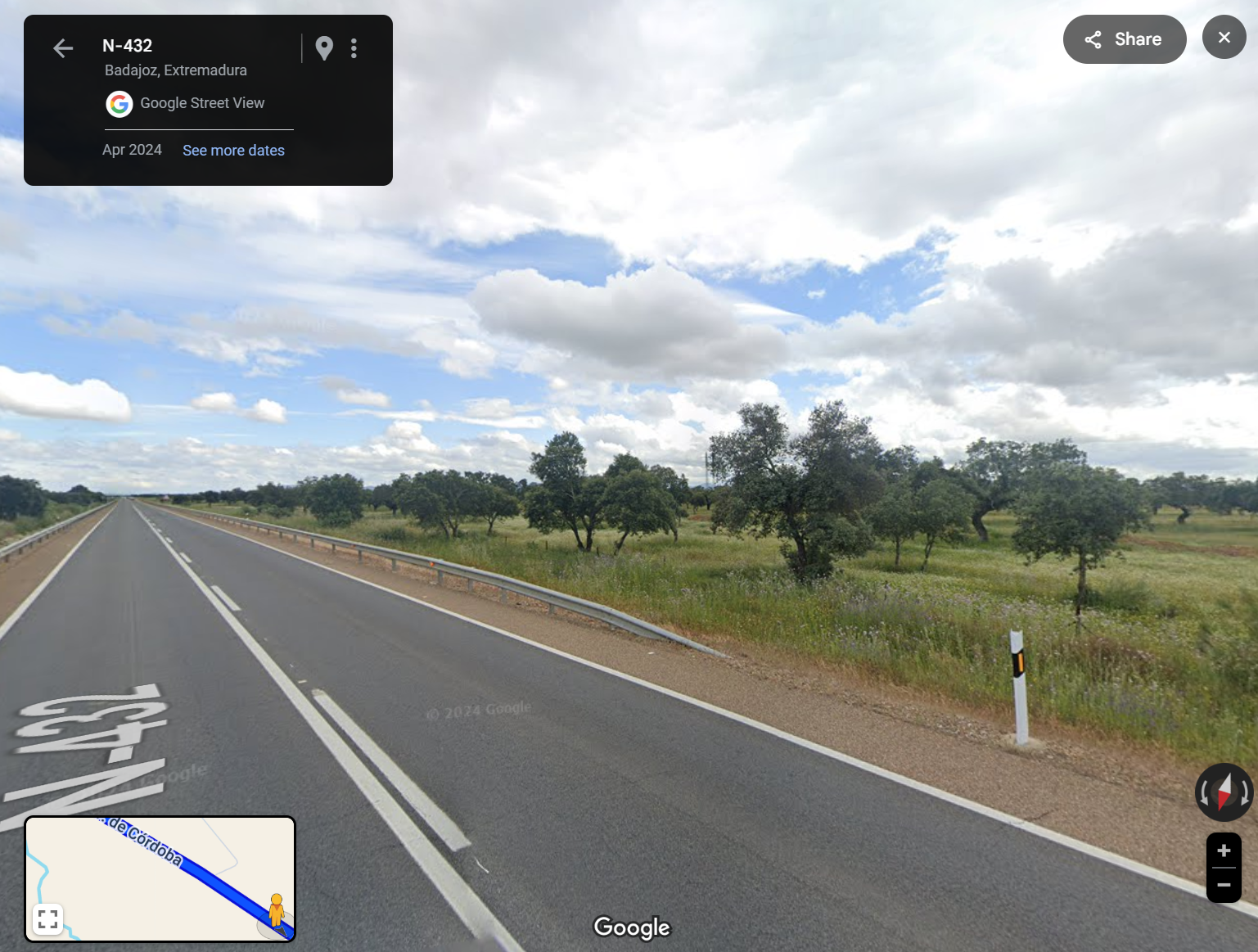
From looking at the map, we expected about 3½ hours of highway driving. But in reality, the area is agricultural so more than once we found ourselves behind trucks and farming machinery or going through small towns, so it took a bit longer.
We had a big breakfast before leaving so we didn't stop for lunch. We checked in to our hotel, the Eurostars Guadalquiver, then grabbed a bite around the corner at Bar/Cafetería Los Remedios. I am sorry to say I don't remember much about the food but I do recall prompt and friendly service. It was fun to see the mix of people coming in to share this coffee shop / restaurant / bar toward the end of the work day.
Eurostars Quadalquiver was pretty nice. It had the most "urban" feel to it of any place we had stayed so far, even Barcelona. The lobby is on the second floor, and other than that, a card key is needed to access elevators to the rest of the property. They also have a dedicated level in the public parking garage, with direct, keyed access to elevators and I can easily say this was the brightest, cleanest garage I have ever seen. It's located on a major avenue with entrance under a blocks-long awning what gave us a place to wander about upon our rainy arrival.
| Ceiling of Lalola, in the glass-roofed courtyard of the Hotel One Shot Palacio. Glassed courtyards were fairly common throughout our travels. |
|
The room was not as fancy as I might have thought judging from the lobby, but it was nice. We were on the top floor with a decently sized balcony overlooking the neighborhood behind the hotel. The relatively large bathroom had a full-size ahower with actual sliding door (what is this European obsession with half-doors on showers? I mean, I know the floors are tile, but who wants the floor all wet?). There was a cheerful red and white tile motif repeated in the bathroom, the headboard, and the patio.
Observation: Looking out over the residential area from our balcony, I was interested and surprised to see all the television aerials sticking up over every apartment. I couldn't make a meaningful photo of it so had to be content with capturing a grouping of construction cranes in the distance, which you can see in the thumbnail photo banner at the top of the page.
We cabbed it to our dinner reservation at Lalola de Javi Abascal. The menu centers on traditional Iberian cuisine and ingredients from the Sierra de Huelva region to the northwest of Seville. We were excited to see a "butter service" on the menu and of course had to give that a try. Then I had the pork tenderloin with sweet corn cream, and my husband had the Iberian presa. I believe this is the first place where we learned about this particular cut, as well as the pluma and the secreto. Now I will have to see if I can get a butcher in the US to cut some presa for us, because it lived up to its melt-in-your-mouth description, and we sought this out at other stops on our trip.
This restaurant provided a good opportunity to try foods that in the US we consider less appealing, such as pig ear, beef tongue, tripe, and even lizard, but I confess I chickened out. I really need to become more adventurous, since I am certain these Michelin chefs make it all delicious, and honestly, using every part of the animal goes along with my beliefs. But some of the English translations don't help, like cured or fermented sometimes showing up as "rancid" or cod tripe as the even less appealing "fish guts."
The restaurant overall was worth the visit, but the environment was not very relaxing. It was brightly lit, which seems more common in Spain than in the US, but it felt a little glaring. It occupied half the courtyard of a hotel, so it was also a bit chilly and echoey, and the glass roof was leaking just slightly. The service was nice though, and they took time to explain the dishes and help us order.
Our hotel in Los Remedios neighborhood was not in the heart of the touristy area, but more of a medical and business district. There were some casual restaurants and clothing and other retail stores, but for our sightseeing we needed to walk one of the many bridges crossing the Guadalquiver River. So of course we were happy when we woke up to clearning skies and warm temperatures. We chose the Puente de los Remedios to start our walking route.
The bridge lands in El Provenir neighborhood with entry into the Parque de María Luisa, whose nearly 100 acres are dotted with ponds and fountains. Following its numerous footpaths, you will find mouments, gardens, and museums. Some buildings within the park date from the late 17th century, with royal, government, and civic uses. Others, such as in the Plaza de América and the famously gorgeous Plaza de España, were built for the spring 1929 Ibero-American Exposition during pre-depression optimism. The Plaza de España was used in filming Lawrence of Arabia, but you might feel more like you are in Naboo of Star Wars fame. If you like using film to create an itinerary, you will also find Plaza de España and other Seville scenes in Game of Thrones.
|
|
|
|
|
|
|
|
|
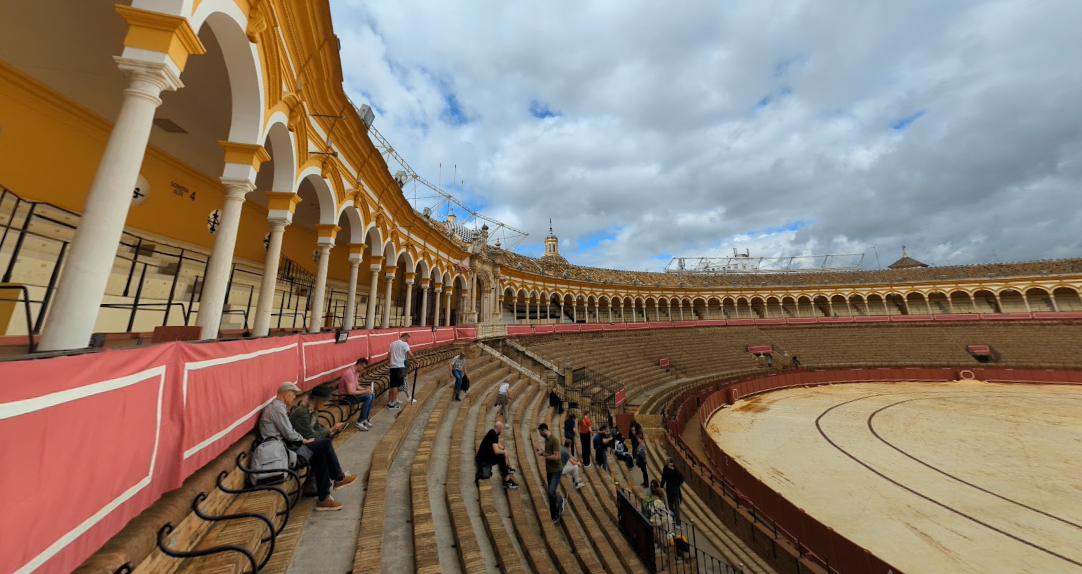
| Clockwise: Bullfighter's traje de luces. Fountain with lilies, María Luisa park. Plaza de España: ceramic tile bridges; columnade; panorama. Royal Alcazar: outside along the Jardines de Murillo; lion gate. Plaza de Toros: bull statue; statue of Curro Romero; the arena and stands; bull's gate. |
|
|
|
|
|
|
As I mentioned, what you plan on a map might not be what you can do in 3-D. Seville is quite flat, so this time we we not thwarted by hills. Instead, where we had planned to cut through Jardines de Murillo, we were flanked by a wall to the end of the gardens. It was a pleasant walk of wide sand paths, beautiful plantings, and fountains. From there we found ourselves swept up in some tourist groups through winding halls and streets (Google street view).
Observation: Fresh squeezed orange juice! There are orange trees growing all over the city. Many cafes have machines to press oranges for fresh juice. I typically stick to water but had forgotten my bottle and that juice was so delicious and refreshing. You should try it at least once.
We exited through the Lion's gate of the Royal Alcazar, which lay behind that wall that had prevented our shortcut. Our plan had been to walk by this 11th-century Moorish palace inside the park, but only in trying to reconstruct our walk did I see that it is contained and has an entry fee. Upon seeing some of the photos online, I wish we had gone - it will make the list for a return visit for sure.
We crossed the plaza and joined the Avenida de la Constitución, a wide street devoted to a tram route and otherwise reserved for pedestrians. I wish we had more of this in US cities!
We passed by the Archivo de Indias, built in the late 16th century for the merchants' guild and later repurposed by Carlos III as the repository of the history of the Spanish empire in the Americas and Asia.
Making our way back toward the river, we passed the Edificio Coliseo, constructed as a theater for the 1929 Exposition whose interior has been completely remodeled to house a bank and other businesses. We turned up the Paseo de Cristóbal Colón and spotted the Torre de Oro watchtower next to the river.
We continued to the bull fighting stadium, the Plaza de Toros de la Real Maestranza de Caballería de Sevilla. We debated going into this venue that is such a part of Spain's traditional and historical culture, as we don't support sports and amusements that involve animals. But we decided to take a look. One take-away I had from the museum at the arena was that bullfighting arose as a means of keeping cavalry and infantry trained, but humans confronting bulls has ancient roots in Greek and Roman empires and throughout history and seems to have much more activity for sport than utility.
Observation: Bullfighting has been banned in many cities but is still legal in Spain and several other countries. Some steps have been taken to make it less cruel. At least in some places, the beef is eaten and not wasted.
During the museum hours, you can see history and artwork and visit the chapel where the buillfighters would go to pray before their matches: after all, the sport has a high injury rate and deaths even in modern times; according to this article, surgeons developed special techniques to treat horn injuries. Perhaps just focus on the elaborate trajes de luces, or suits of lights, that can take months to complete before worn by the fighters.
You can walk around much of the stadium which was built in the mid-1700s. It was interesting to sit in the stands and imagine them filled with spectators from then and also from today.
|
|
|
|
More hoofin' it, this time to Las Setas de Sevilla. Las Setas were built to replace an old market but when they began digging for the planned underground parking, they discovered ancient ruins. Work was halted and a competition opened to redesign the site. That lower level now is a museum. The structure's original name was the parasols, but it became know as the setas (mushrooms) due to its look of organically sprouting from the ground.
|
|
Map on building that currently seems to be the Abba hotel. |
|
| Edificio de la Adriática. | ||
| Millstones in wall of Archbishop's palace. | ||
|
|
||
There was no market happening at the ground (open-air) level when we went, but we eagerly bought the tickets and climbed up to the top for views of Seville and to experience the building itself. The wood and resin construction is fascinating from artistic and engineering perspectives.
Inside the upper level, there is an immersive video experience using music, imagery, visual story-telling, and even scent to give an impression of the history and culture of Seville. Don't miss this when you go.
In the evening we had tickets for a Flamenco performance at Tablao Flamenco Azahar. We were a bit early and the address seemed like a little hole in the wall with no activity, so we weren't initially sure we were even in the right place. But soon the door opened and we were shown in - directly into a small room lined on three sides by two rows of chairs. This was truly going to be an intimate experience.
Soon the room filled and we were introduced to the singer, the guitarist, and the dancer. I was especially happy to have seen moods of the Flamenco dance in the video at Las Setas, as I felt it enhanced my appreciation. I was not aware of the history or even the character of Flamenco. I guess I thought it was just showy dance, but it really has much more of a rooted and indigenous feel, almost like there is some story-telling and communication going on that I can't translate. All three performers were terrific but I was particularly impressed with the guitarist, who looked quite young. I definitely recommend this experience for its historical and authentic atmosphere.
We wandered in the direction of our hotel and stopped in Restaurante Bendala Brasería for dinner. A look at their online menu did not help me recall what we ate, and I guess I don't have strong feeling either way about how much we liked it. The menu does look to have some nice selections for vegetarians, which might be a little hard to come by in this land of tasty pork and seafood.
|
|
|
|
|
|
||
| Triana neighborhood sights: Campilla Virgen del Carmen at the Puente de Isable II; Mural of painted tiles at the Ceramic Center; Ceramic tiled home; Triana Ceramic Center exterior. | ||
Early-ish in the morning my husband tried to hit photography's "golden hour" at the Plaza de España to try to get the warm-colored brick in the warm hued sunlight. It was only partly successful due to the orientation of the half-circle plaza, much of which lay in its own shadow. If you are a dedicated photographer, you might want to research the hours and times of year for the best lighting. But the area is beautiful at any time, so no visit (or re-visit) will be wasted.
When he got back (I was probably sleeping or being otherwise lazy) we decided to wander the Triana neighborhood. We walked back toward the river then followed the water's edge to the Puente de Isabel II, aka Puente de Triana. We wandered through the mercado.
Near the market were many ceramics shops selling decorative tiles and other pottery. And in fact this is one of the ceramics centers. We passed a building covered in 3-D geometric artwork, and when I peered down a hallway to see what it was, we found it was the Triana Ceramic Center. It cost only a couple euros each, so of course we went in. The museum / gallery is an interesting, modern building on the site of an old pottery manufacturing area, so you can see some of the actual kilns and tools. A video includes interviews with people who worked in the very physical and smoky (due to kiln fires) craft.
We roamed the streets of this residential neighborhood and saw people living and working here, with few tourists. Plenty of workmen going in and out of apartments and other buildings, laundry hanging from windows to dry. We passed churches, schools, a handball court, parks, sports centers and more.
We had left this day open, so that we could catch up on anything we missed, perhaps due to weather or fatigue. We used the afternoon to find a nearby laundromat. One of the dryers was out of order, so we had a bit of a wait ahead of us. The lady whose turn came before ours seemed nice and we thought she might prevent our clothes from being thrown on the floor or stolen, so we left for a quick lunch.
We found Casa Rafel, which was just opening for lunch. We were seated at the bar and enjoyed watching the activities of the staff and the diners who started to fill up a table. The place is tiny and was very good. We felt conscious of being in a bit of a rush, because even at lunch while it was not a white-linen sort of place the place settings gave an upscale feel, plus hurried meals are just not the style in Spain.
|
|
| Paddlers in Guadalquiver River, with Puete de San Telmo and Torre de Oro in distance. Taken from Puente de los Remedios. |
Travel Tip: When using a laundromat, take time to read and translate all the instructions. It turned out that the machines we were using (here and elsewhere) include the detergent. I checked this after I saw some suds on the washer door as I moved the clothes to the dryer.
For the evening, we headed once again to the Plaze de España and actually timed the light for some better photos. We meandered along the river walk on that side of the river and then again down the Avenida de la Constitución.
We consulted the map and Google search to find some dinner and chose the highly-rated Vuela Tapas and Cocktail. We stuck our heads in the door to learn that they were not yet open, so we made a reservation to come back at opening time. The people were friendly, the menu fresh and changing, and there was a good selection of interesting cocktails and wine.
A Sphere photo of the Plaza de España in golden hour light. Click here
to see it in a Sphere viewer and move around in the space.