|
|
|
|
|
|
|
|
|
|
|
|
|
|
|
|
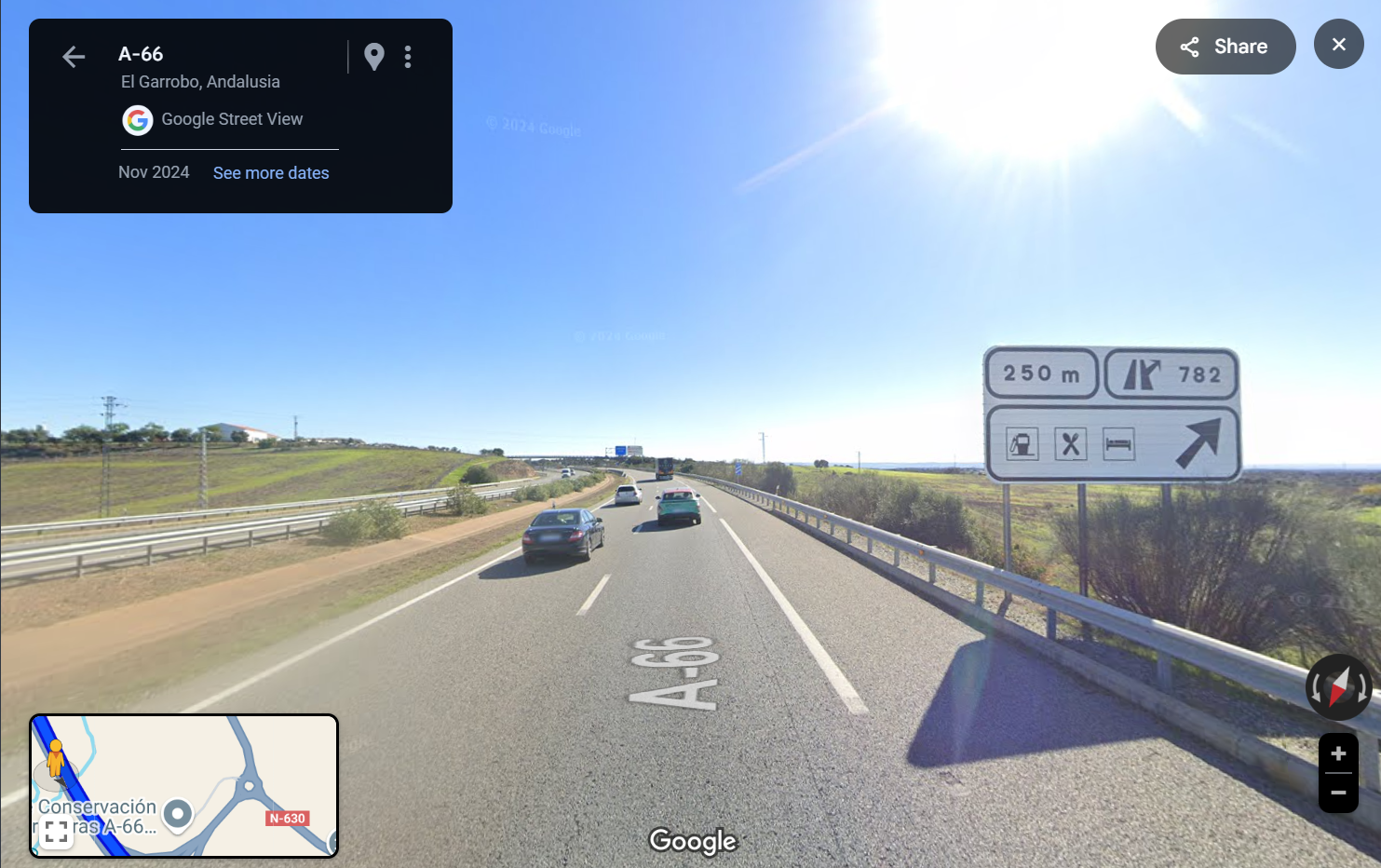
| Google street view of A-66 highway, our route from Seville to Madrid. On the map it is also labeled as E-803 and also takes on some local numbers in towns. It took us awhile to become confident with our navigation. |
Another driving day, as we headed to Madrid. This would be our longest drive, estimated at 5½ hours by Google maps. As we were preparing to leave, we caught the voice navigation saying something about the route passing through a restricted zone. We stopped to investigate and flipped out a bit to learn about a fine of €200 - €1800 if you drove some places in a car that was not certified as a low emission vehicle. We found that our rental qualified, but there was no reasonable and timely way to register it without being the owner.
We were afraid we would need to find a hotel outside the ZBEs - zonas de bajas emisiones but when we called, we learned that the hotel would be able to register us during our stay. Technically, it is not the hotel that is allowed; it is the parking owner. Some parking lots can register you, but hotels that don't have parking cannot. There is a lot of information online about how this works, but it's almost too much, such that I didn't feel confident about details like whether or not we would be ticketed en route to the hotel. We decided the best tack was to drive there, re-confirm the registration as we checked in, then just leave the car parked until our departure. We didn't want to be driving around Madrid anyway.
Travel Tip: Research your driving routes before traveling. This is true for rental cars or with your own car. More cities throughout the world are creating special low-emissions zones or demand-pricing on tolling. You don't want to be hit with surprise fees or fines.
We retraced part of the route between Estremoz to Seville before turning northeast. From the credit card statement I determined that we stopped for lunch at Vuelta y Vuelta in Zafra. It seemed like a very local, fútbol-forward restaurant, but there wasn't too much going on as we arrived right as they were opening. I believe my husband had the Solomillo iberico. I ordered a salad and some fried anchovies. To my surprise, the salad - of grilled lettuces - arrived topped with that awesome Spanish ham and with anchovies. It was very fresh and tasty, and quite filling.
There was a long delay for the fried anchovies to come, so I assumed for some reason they must have been added to the salad, though they didn't seem especially fried. We asked for the check and were informed that we hadn't gotten all our food. Soon, she set down a giant plate of batter-fried anchovies. We ate some and took the rest with us. The experience was a bit odd. There was definitely some language barrier, with our limited Spanish. In retrospect, I realized they may have been waiting for the fryers to heat up. But the food was very good and I would go back, especially if I could be there when some sports matches were on.
|
|
Night scene on the Gran Vía
Dinner in a cafetería near the hotel. Notice how brightly lit it is. Those beer taps at the right would be the local Mahou with taps for light, dark, and non-alcoholic. |
|
|
|
We arrived at our hotel, the Exe Suites 33, checked in, and got the car parked. We were happy to have a kitchenette, especially with all the leftover anchovies. But the room layout was odd. There was a hallway inside the door - this can be nice, as it generally blocks noise and light from the shared hallway, plus it gives you a place to leave your shoes, backpacks, umbrellas etc to keep down the clutter. But where it turned to come into the kitchenette, it took some awkward dog-leg around a water heater (yes, that's right!). It had a bit of an older feel to it, but the bed was comfortable enough. There was a lot of street noise, unfortunately only having quiet from about 2-3am until 6am.
Through our stay, the staff was nice enough, but a lot of things they said they would do, they didn't really. For example, getting wine glasses or a knife - they said they would bring them up but didn't, so you'd have to go back down and get them (even though I offered to take them at the time). Or the ironing board we borrowed that they seemed to want to take back right away in the morning but then sat there for the rest of our stay. But hey, we used it again and we had space in that big hallway that I mentioned, so not really any problem.
Travel Tip: Ask at the front desk for info that tourists should know, like free bus routes, or things going on in the area to attend or avoid, like events, protests, or construction. During our stay of just a few days, we saw a Walk for Freedom (human trafficking awareness), a Gay Pride parade, and a protest in support of Palestine, though they all seemed well organized and non-disruptive.
But I must give a huge shout out to - oh no, I've forgotten his name! - the young gentleman at the desk who clued us in on city bus routes 001 and 002, which are FREE and run to a lot of the ground we wanted to cover. Because we needed a hotel with parking, I had to pick one that was not quite as centrally located as desired, and the first step of the walking tour was to find the metro to take it to our starting point. But with the bus, we were able to see sights along the way and get right where we needed to be.
We took a nighttime walk around the hotel, up to Santo Domingo plaza and along the Gran Vía shopping area. This being Spain, there were tons of people out and about and it was quite energetic. I felt safe but guarded in the crowds, as it seemed a likely pickpocket area.
Observation: Cider seems to be popular in Madrid, along with beer. You can find spots named Sidrería or Cervecería everywhere.
I had wanted to go to the very local-feeling Sidrería A'lareira for dinner but it was tiny and crammed full. We found another local restaurant for a bite before turning in for the night.
|
|||
|
|
|
||
After a noisy night of not-great sleep, we stumbled down to Syra Coffee, just down the street from the hotel, for some coffee, tea, and pastries. My recollection was that there was not a huge selection and the price was too high for the quality, but I enjoyed eavesdropping on some young guy saying he had turned down an entry-level engineering job with Formula 1 racing because he would only get to own one part of the car and not the whole car.
Somewhat refreshed and ready for touring, we hopped the Route 001 bus in the direction of Retiro Park. We hopped off a couple stops early so we could walk by the Cibeles fountain and palace and the Alcalá gate, then entered the park from the northwest corner.
What an amazing public space! Or spaces, I should say. At nearly 310 acres, it offers gardens, fountains, trees, monuments, a lake, a puppet theater and playgrounds, and green spaces. You could walk for hours, as I think we did. The park was very busy with families, tourists, artists, exercise groups, and tourists, but it didn't feel crowded. It was, as so many lovely parts of Europe, once owned by the royal family but was "liberated" by revolution after 1868.
We wandered all around, charting various statues and fountains marked on the map. There was an interesting Photos of the Year display along the Avenue de Menéndez Pelayo, the east border of the park. The juried exhibit included professional and amateur photographers and a section of people's-choice awards that we preferred to many of the officially recognized entries.
We exited the park at the southwest corner and walked toward the Prado Museum. We stopped into La Platería Bar Restaurante for some refreshment first. There was a cold appetizer salad I had my eye on to order, but then was delighted to learn that tapas selections were included with our beers, so we ordered a hot dish to share as well. They were very busy and crowded but managed to get us out in time for our timed-entry tickets at the Prado.
|
|
|
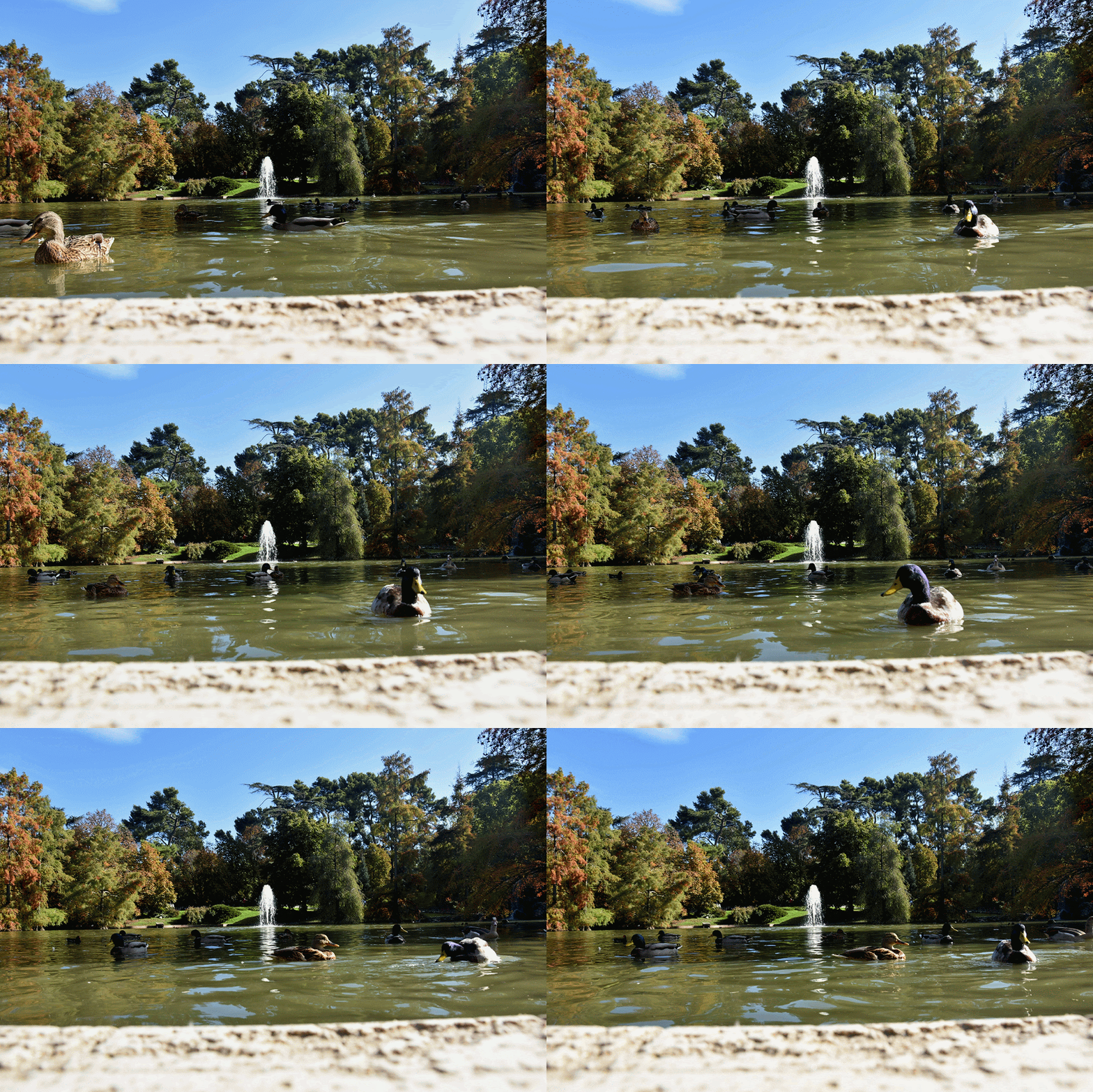
Clockwise: Fountain of the Four Graces. Monument to Alfonso XII and boating pond. Church of Saint Manuel and Saint Benedict, seen from Retiro Park behind the Fuente del Pequeño Tritón. Ducks swimming in the pond in front of Palacio de Cristal. Monument at end of cypress colonade. Busker playing music on glassware. |
|
|
|
|
|
A note about tapas. Tapa means top, and refers to a small bit of food like a piece of bread or slice of ham, that would cover the top of your drink. The origin is uncertain but you can experience tapas in various ways. Many restaurants will set down some bread, potato chips, and olives unasked - these seem free but I spotted them on the bill, usually less than €3 but with very poor quality olives in my opinion. The Platería, like many cafés, had a counter display of cold dishes to choose from, and I was surprised that a choice here was included. The small bites and sharable plates has now become standard fare and includes many hot dishes as well.
We hustled across the street to the famous Prado art museum. There is so much to see here. If you are an art aficionado or student, you might plan to make several trips. For me, no matter how amazing the collection, I have about a 2 to 3 hour max time I can spend in a museum before I can no longer appreciate the works. The Prado's website catalogs the whole (I think) collection so if you are serious you could use that to prioritize your visit. They also have guided and audio tours and some suggested 1-3 hour itineraries.
Travel Tip: Note your Prado entry on the map. There is, of course, security at the museum entrance, but there are free cloakrooms to check your items (including camera). But there is more than one entrance and cloakroom. After immersing ourselves in the galleries, we had gotten completely turned around so that the signs we followed to the exit took us away from where we needed to be. It was confusing to figure out which signs to follow.
|
|
|
|
|
Monument to artist Diego Rodríguez de Silva y Velázquez outside The Prado. Church of San Jerónimo el Real, on hill behind the Prado. |
At the Prado, we saw classical paintings by many Spanish artists that were unknown to us, as well as works by famous European masters. The collection includes many sculptures from throughout the ages, which particularly interested my husband. I was not familiar with Goya despite having heard the name; I learned that I don't really care for his paintings.
I did however really admire the works of El Greco and how you could see the emergence of expression in his later works and in those of his student displayed in the same room. According to Wikipedia, those works puzzled his contemporaries but are now seen as precursors to expressionism and cubism.
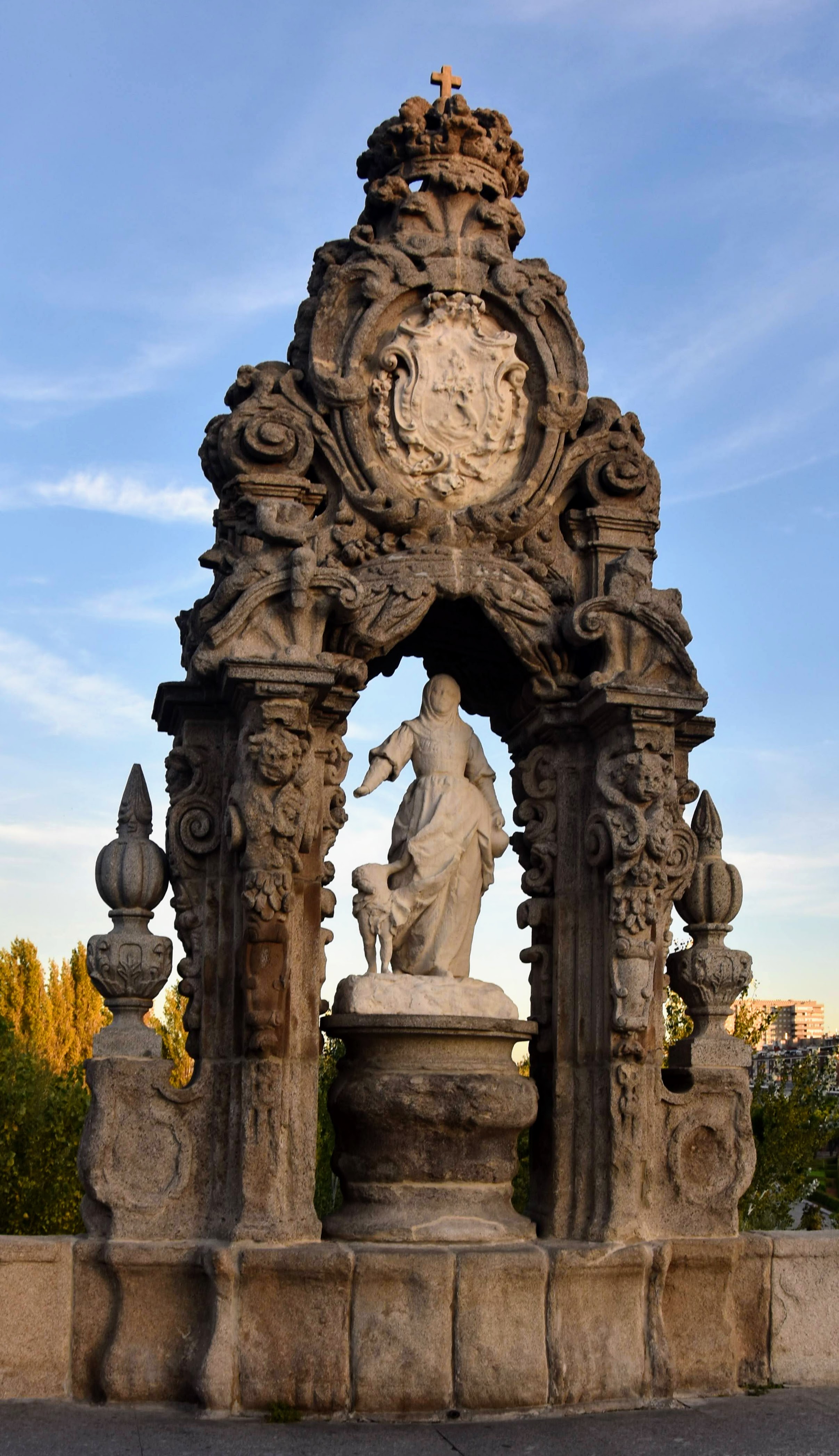
Another favorite was seeing Vincente López Portaña's rich treatment of textiles. I thought we saw Strazza's Veiled Virgin sculpture, but upon research, I see it was the also impressive Isabel II Veiled by Camillo Torreggiani around the same time period (1850s).
| Afternoon tea in the Palm Room of the Oriental Mandarin. |
|
|
I read one comment about the Prado was that it was not the most diverse of museums. But you could counter that with the benefit of its having higher numbers of works by many of the artists. I feel can better value and understand what an artist is doing when I see their works over time and how they change and grow in their interpretations and abilities. The Prado also does a good job of telling stories behind many of the works so you can learn the meanings of the elements.
After the Prado, we did something a little uncharacteristic. I dragged my skeptical husband to afternoon tea at the Mandarin Oriental. I, did I mention, it's the Ritz? Very fancy. On a trip with my grandmother long, long ago, we had gone to high tea in Hong Kong. But the reason I chose the tea was mainly as a means to sit inside the gorgeous, glass enclosed Palm Room.
The tea, though, was terrific. We were greeted with a glass of champagne while we perused the tea menu. I was finally able to try the lapsang souchong tea I had read about (spoiler: smoky and dark, maybe more interesting than good, but I'd be willing to try it again and see. Especially in the Palm Room!).
We were presented with our pots of tea and a tiered tray of finger sandwiches and goodies. I was trying to feel very fancy, even though we were dressed more for walking miles around the city. We were not the worst-dressed or least fancy people I saw, but the staff was prompt and gracious to all.
I think we grabbed the bus going back to the hotel, getting off at the Plaza de España (yes, probably most cities in Spain have one of these). I am not sure; we might have walked.
After a little clean-up, we walked to dinner at El Cisne Azul, north of the Gran Vía in the Chueca neighborhood. The name means blue swan, but we chose it for its focus on mushrooms. Fall rains bring up many seasonal mushrooms and they are popular in Spain. We followed the guidance of the server and had a delicious meal.
We enjoyed our return walk after dinner. In fact, walking after dinner should just be a thing since it feels very good and is reportedly also good for your health. I had hoped to stop in some local bar and catch the Real Madrid game, thinking it might be a rowdy fun time. We did find a little spot but only the bartender was paying any attention to the match.
In the morning we had some free time. We put the kitchenette to use and ate up our leftovers for brunch. Then we went back up the Gran Vía to visit the Atlético Madrid fan shop we had seen the previous day and get a bucket hat gift for a soccer fan in the family. This because the big plan for the day was to take in a match.
Soon it was time to learn to use the metro. We got cards that were good for 2 trips each - I recall that you paid by trip regardless of distance. We weren't entirely sure how it would go since we had to change lines. Disaster almost happened though, when I realized that an ID was required for entry and driver's license was with my passport in the safe. We jumped off at the first stop, then I ran to catch the train in the other direction to go back and get it. Good thing we had left plenty early.
I rejoined my husband and we got back on the train headed to the stadium. After we changed trains, the train at each stop became more crowded with fans. We arrived with plenty of time to spare so grabbed a couple beers outside the stadium and found some seats under a tent and out of the sun.
|
|
||
|
|
Top: Exterior of Civitas Metropolitano. Left: Atlético mascot Indi, a raccoon with Apache headdress. Right: Our seats were close to the action. Bottom: Interior of Civitas Metropolitano and pre-game activity. |
|
|
|
||
We entered the stadium a little early. I had found us seats in the front row right behind the visitors' bench. When we got there, a bunch of teens or tweens were hanging out in out seats. They were polite and one of them explained they were trying to get selfies with the players, so we just moved to the side.
The match was fun, but honestly, seats up a little higher would have given a better overall view. Also, sitting that close, you have to pay attention. The ball will come up into the stands. I took a ball in the face, fortunately not full speed off the field, but when I turned to look as it came back down from behind. Interesting to note, no alcohol is sold in the stadium, but you are allowed to leave and reenter once (we didn't).
|
|
|
Plaza Chueca cow sculpture, one of a city-wide art project. |
|
|
|
Flamenco shawl art design on hotel near Santo Domingo. |
Another observation about the soccer match was that it was much more calm than I expected. One of my reasons for going was to be immersed in the rowdiness of international soccer. We went to an Arsenal match in London and it was nuts. And the US fans have learned to be like English and Mexican fans. So I was expecting something quite loud and emocional. But it was fairly sedate. The small section visiting from Leganés (which is just an hour outside of Madrid) were louder than the whole rest of hte stadium. Surprised more than disappointed, and at least no fights broke out.
I never had to show my ID. But hey, don't rely on that if you go! And we each had to put more money on the metro card to get back, though mine needed more, as expected.
When we got back we wandered around looking for some dinner. We chose Restaurante Himalaya, an Indian restaurant not far from Plaza de Santo Domingo. It was terrific. In the downstairs, there was a glassed area in the floor, looking into what appeared to be some ruins. When we asked the server about it, he said no, they had installed that in the building as artwork when they opened over 40 years ago.
Travel Tip: Try ethnic restaurants when you travel. Of course one of the reasons we travel is to learn about other people and cultures. But on a long trip, don't be afraid to try the kinds of foods you eat at home too, and see what is the interpretation there. We didn't really do this, except for this Indian restaurant, but I probably would plan for some of this on any trip longer than 2 weeks with the same general cuisine. You might be surprised - the Indian in Madrid was great, but the Mexican I had in Munich had to be some of the worst I have tasted, despite its glowing local reviews.
For the evening, we thought we'd try to catch the second half of a Seahawks game. I had read about a sports bar Malasaña that showed NFL games and I thought it would be interesting to see. We found the place and they had a few games on, alright. But it was really a video game place, not in an open room but more arranged in a narrow circle around some central part of the building (kitchen? bathrooms?) so that each tv was basically in a hallway. We found the 'Hawks game - there was a big tv with about 6 barstools across from it, all occupied. We couldn't really squeeze in in front of people, so we called it a night.
|
|
|
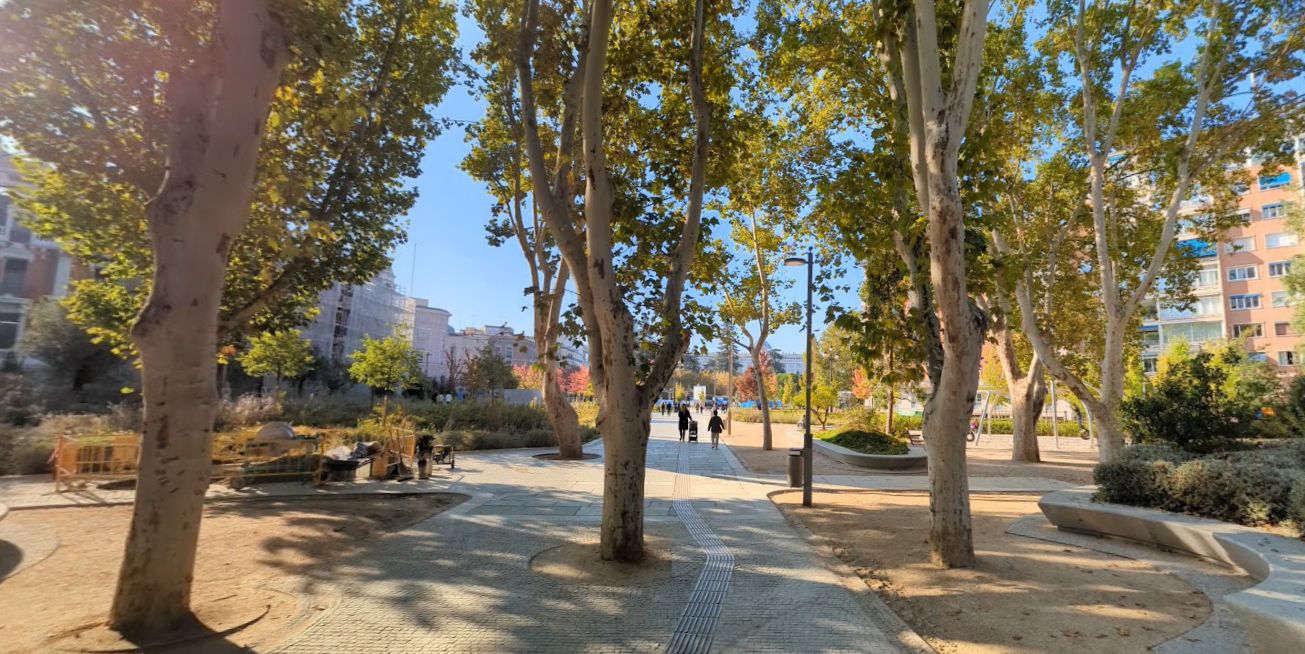
| Cervantes monument and park scene in the Plaza de España. Click here for a photosphere to move around in the space. | |
Day three in Madrid brings us to another walking tour, this time along the west side of the core tourist area.
We started by exploring the Plaza de España, its monuments, and the trees starting to pick up some fall color. This is a busy square along some main streets. It's a great place to catch a bus or metro or to take in a demonstration or protest.
We then continued along Calle de Bailén past the Royal Palace. The area was partially blocked due to some renovations but we could look down at the royal gardens and admire the building as we passed. We cut through the Plaza de Oriente with its gardens and monuments.
I made the executive decision to pop into Bajo Cero, an ice cream and treat shop. But I was there for a breakfast of the chocolate and churros I had heard about.
The churros were crisp and tender, served plain for dipping in the cup of warm, thick chocolate. They were not the grease and cinnamon-sugar bomb ones I've tasted (and now decline) at home. Fortunately the shop also had real breakfast food as well, so at least one of us could make a healthy choice.
|
|
|
| The Royal Palace and adjacent Plaza de Oriente. | |
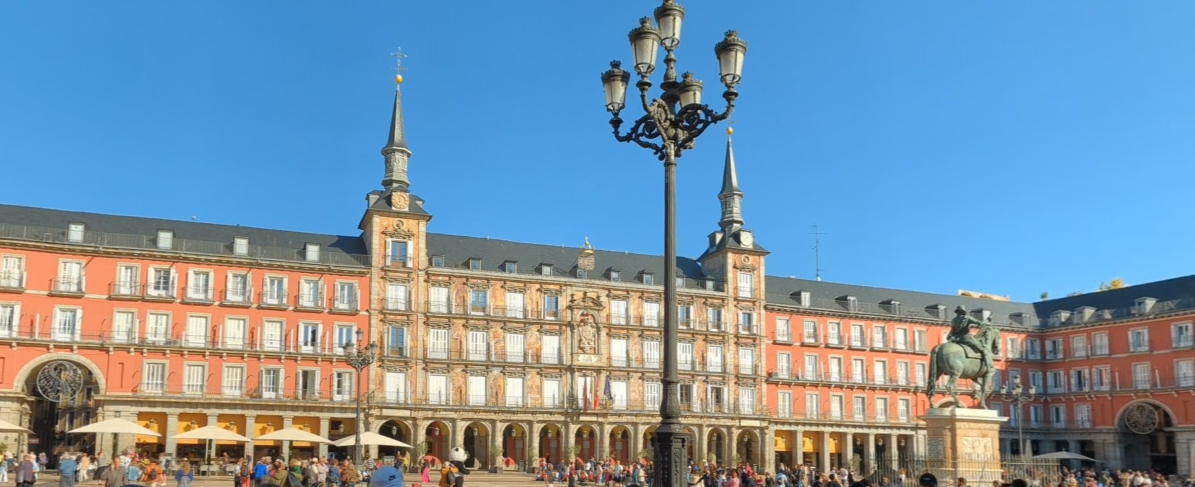
We trekked the narrow Calle de la Escalinata and Calle del Mesón de Paños to Plaza Mayor. Yes, most cities and towns will also have a Plaza Mayor.
This one is home to the Casa de la Carnicería and Casa de la Panadería which from the 16th century served as the main butcher and bakery centers providing meats and breads to all the markets in Madrid. Of course today they are occupied by civic and retail ventures.
|
|
| Plaza Mayor. Click here for a photosphere to move around in the space. |
At noon we joined our tour of El Sobrino de Botín. According to the tour information and backed by Guinness book of records, this is the oldest continuously operating restaurant in the world. Opened in 1725, its doors remained open in some way or another through multiple ups and downs.
The tour is worthwhile, as it takes you through the history of the building including the wine cellar with secret tunnels under the old city walls and the original oven whose 300-year-old fire is flavored by the oak whose acorns feed the Iberico pigs.
We learned that when Botín opened, restaurants only cooked food brought by patrons and were forbidden to sell foods otherwise, so they had a strategic location right outside the city wall from the markets in Plaza Mayor. We thought our guide, who was English but had lived in Spain for twenty years, did a really nice job explaining the history and especially in politely keeping a 5-year-old engaged so his parents could also enjoy the tour.
Observation: I got a lot of dining ideas from this food tour video. I wanted to hit all of these but some didn't fit the schedule. This is also what made me want to try some foods I subsequently declined when I had to opportunity.
The Botín Experience tour includes lunch and if you answer quickly, you might even get to eat at the table frequented by Ernest Hemingway, which you could read about in his The Sun Also Rises. The food was good, but a little heavy for lunch, being wood-oven roasted meats, and with us on a walking day and not just going straight to siesta afterward. We were given a souvenir plate, which fortunately made it home intact.
|
|
|
|
|
| Scenes from El Sobrino de Botín: Old wine cellar. Old basement dining room. Botín's wood oven and some of the day's supply of suckling pigs. Newer, upstairs dining room. | |||
|
|
|
|
|
|
| Lavapiés neighborhood street scenes. | |
After our Botín lunch, we had to schlep our full bellies over to the Reina Sofía art museum. This museum is low-key compared to the Prado or the Thyssen-Bornemisza museum that we will include in our next visit. We had pre-purchased tickets but there was no set time for entry.
To me, the feel was more casual and the collections more enjoyable or approachable, or perhaps I should just say enjoyable in a different way than the more formal works of the Prado. But this is still a serious museum, with collections of avant garde works, exhibits about the intersection of art in different media and popular culture, and rooms dedicated to single artists so you can see their evolution. Importantly, there are many works by Dalí, Miró, and Picasso, including his Guernica. The space dedicate to this famous work included a set of studies and you could see how the idea for the work changed over time.
There was a series of rooms displaying works by Soledad Sevilla that were were particularly admiring, walking back and forth to compare them and comment on aspects we liked. There was a woman there with a camera-man who seemed to be filming a news segment. She asked me if I would like to comment. I objected that I don't really know anything about art. She countered that they were just trying to capture people's experiences in the museum. I objected that my Spanish wasn't good enough; she said to just try. So I did (not on camera) and she said thanks and moved on. Guess I need to keep working on Duolingo.
|
|
| Atocha commuter train station, which also has a botanical garden inside. |
I had planned out a route along the southern part of this central tourist area, through the Lavapiés neighbood which I read was known for street art. I didn't get pictures but you can find examples online. We walked by the Mercado de San Fernando and then down Calle del Casino, passing Parque Casino de la Reina that was full of families enjoying the warm afternoon. By this point we were pretty well outside tourist areas and were getting more feel of what it could be like living in Madrid.
We spotted a shop, Taste of America, so of course we had to check it out and see how authentic it was. They nailed it. The main things I recall are the candies, cereals, mixes (mac'n'cheese, cakes, etc.), and the Jif peanut butter which has got to be the most crap peanut butter there is (ok, there are probably worse ones, but once you try peanut butter that is made from only peanuts and salt, you can't go back). Most everything there was the worst of foods, in my arguable very biased opinion. Yet if I were an ex-pat, who knows, maybe I would find myself shopping there!
We joined a main thoroughfare leading to a large roundabout connecting 6 major roads, with the Puerta de Toledo in the center. The Madrid city walls had been expanded in the early 1600s, and this monumental gate was built in in the early 1800s. The city walls were torn down in the revolution of the mid-1800s but a small section still remaining at the fire station there at the circle.
At this point, the plan was to turn up the hill and towards our dinner reservation, but we had time to spare so decided to continue outside the central area and down to the Manzanares River. The streets were lined with modern offices and apartments, with lots of restaurants and shops at ground level. But the architecture neatly tied in with traditional scenery and it was quite lovely.
|
|
|
|
| Toledo Gate. | Park along the Manzanares River. | Statue on the pedestrian Puente de Toledo. |
At the bottom of the hill, both sides of the river are flanked by wonderful parks. We crossed the pedestrian bridge up at street level, but there were more paths, bike lanes, and bridges down closer to the water level as well. Looking at it now on Google maps, I can see there lots of features like gardens, skate parks, playfields, playgrounds, art centers and more. And the paths continue up and down the river, with more footbridges. I expect I could spend a day just exploring the river, and it would absolutely be a great place to live near.
Observation: The middle of the pedestrian bridge was occupied by a man with a boom box and microphone, singing loudly and badly. I will drop some dollars in the hat for buskers whose skill enhances my experience of a place, like that glass musician in Retiro Park. But could cities everywhere please ban electronically amplified "performances"? They just ruin it.
We knew if we needed to, we could take the magical 002 bus back up the hill to our dinner, but we managed to walk it, taking a couple breathers along the way. Our reservation was at Posada de la Villa, another historic restaurant with claim of being the oldest restaurant in Madrid. It in fact pre-dates Botín but was not in continuous operation. It like Botín uses a centuries-old wood oven and offers a similar menu. I think we would have liked this better if we had not already had the Botín experience in the same day. If you are just looking for dining, we might suggest a slight preference for Posada. They also give you a little souvenir, a "key to the city".
|
|
|
Glorieta de las Pirámides - Obelisks at the Puente de Toledo roundabout. |
|
|
|
Posada de la Villa's wood-fired oven, inscribed 1642. |
On our walk back to the hotel, we weren't ready to turn in yet, so we stopped into El Escarpin and I finally got to try the cider, which was light and dry and drank more like a shandy or even some Pét nat wines I have had. The waiter was surprised that we didn't want food, but I explained that we were full and no era una buena idea visitar Sobríno y Pasado en el mismo día to which he laughed.
Still looking for some nightlife, we went north of the Gran Vía to the streets we had walked on the way to the Cisne Azul and found The Love Company which seems hoppin'. We got some beers and squeezed into a small table next to a group of young women who might have been exchange students, talking in a mix of English and Spanish. They were playing American music and we were happy to be presented with a free bowl of tasty popcorn. Sure, I will eat popcorn even on a full stomach!
Next, we went nextdoor and upstairs to their partner, Bad Company, and got a cocktail each. I thought this place seemed a little weird - the guy at the bar acted odd when we asked about a table even though the place didn't seem busy. We got a seat on a little couch with a low table that had a bowl of candy like Starburst and whatnot. It was very dim and just had this vibe like, I did not really want to see that couch in daylight. But, when I tried to find a link to the place, I only saw one picture that matched what we saw, and the rest of the photos and reviews were of crazy themed cocktails served in a speak-easy in the basement. So who knows? Anyway, we were out for something different and we found it.
Well, our preceding nightlife caused us to require a familiar breakfast, and there was a McDonald's around the corner. Of course why go to American chains when you travel? But it was still cool to see how similar and how different they were. We got Egg McMuffins and they had ham instead of Canadian bacon. And they were giant compared to what we get at home, with much higher quality egg. So even something like this can be a fun travel experience.
We packed up, checked out, and got on the road to Valencia.