Priorat and Montsant wine regions, Spain
October 2024

Spain flag Priorat coat of arms Priorat vista Wine bottles at Celler Masroig Celler de L'Encastell Tarragona coat of arms Olive and vinegar at Brots Old olive mill at Celler Masroig Celler Peyra Tarragona flag

Friday, October 25
Mar Blava restaurant, Celler Masroig, Hostal Sport

Our next destination was the Priorat wine region, about 3 hours drive north. We took a route following the coastline, though we could only see the water on rare occasions. About mid-way, we looked for some lunch and found Mar Blava in Benicarló. This looks like such a fun place to hang out in nice weather - nearly half the seating is on a gravelled terrace out front, facing the beach. Even the inside, which we chose on this blustery day, has an open-air, beachy vibe.

I am sorry that I can't report what we ate there. I think I had a burger, actually. What I do recall is that the food was taking some time and we were unexpectedly presented with an appetizer, gratis. I didn't really feel that the service was too slow, so this was a very nice gesture. The food also was very good. Looking at their menu and photos online makes me want to go back and try more dishes.

Celler Masroig columnar sign Celler Masroig
Celler Masroig, in Montsant DO.

We had a bit more driving before heading up into hilly Priorat, southwest of the Serra de Montsant range, in the state of Tarragona, in the Catalunya autonomous community.

In the US, we had mainly heard of Priorat DOQ. Here we also learned about Montsant DO, which surrounds Priorat like a donut. (Learn more about DOQ and DO.) The land here is steep, rocky, and dry, and terraced like we saw in Douro Valley. It is not suitable for many crops other than grapes and olives, and there is a long history of winemaking here.

The Priorat DO was approved in 1954, but the production and quality were low and the wine was generally sold in bulk. In the late 1970s a group of winemakers set about improving the wines and building the reputation for the region. In the early 2000s, the Montsant DO was made distinct from the rest of lower-lying Tarragona, and Priorat was promoted to DOQ.

Olives of varying ripeness, green to black, at Celler Masroig.
Olives of varying ripeness, Celler Masroig

Along our way, we had a reservation at Celler Masroig, in the small town of El Masroig in Monstant DO. Masroig makes wines, but we were here to taste olive oil. We had a lovely, attentive tour guide who covered both wine and oil, leading us underground through rooms beneath their processing space and shop. Our host talked a lot about taste and how people experience it. Walls of one chamber of the tour were lined with pots of things to smell, and hidden placards that would reveal the contents. I was able to identify a few but not all of the ones I tried.

When it came to the tasting, she told us about the flavor profile of olives from green (grassy, fruity, maybe bitter or sharp) to ripe (more mellow, sweeter or even nutty). Millers achieve the taste they want by blending the fruit itself, rather than blending oils of already pressed fruits. I was curious how this would work, but she showed us that olive trees don't ripen their fruits all at once so it is possible to harvest the desired composition and press throughout the season.

They only had one oil to sample, but there was a little commercial oil to compare it too (theirs was better, of course). Upstairs in the shop, we wanted to get a can of olive oil to bring home, but they only sold it in gallon bottles. You could also bring your own bottle to have it filled, and indeed there was a man from the town doing just that. There were wines there and other local products so we got some small culinary gifts for family that we would be able to mail them once we got home.

We continued through the rainy hills and winding roads to reach our lodging in Falset. We were staying at the Hostal Sport, but there was some confusion finding our reservation. Then, aha, "You're in the apartments?" Yes, a little walk, a few doors down to an apartment building, and we are all set.

Parking was in a community lot around the corner and down the block. The concept of free, overnight, public parking has become foreign in our urban environment, so we were nervous about robbery, damage, or even being towed (free? overnight? really?), but all was well.

View from our apartment in Falset
View from our apartment in Falset.

We had a little place with a kitchen and table, sitting area, laundry, bath, and two small bedrooms. Windows on the front faced the street. From one bedroom and the bathroom, they faced into a glass-roofed courtyard, as we have seen elsewhere on this trip. From the laundry hung out there, I would guess that the building is mostly occupied by full-time residents and not by tourists. We settled on the couch to watch a lightning storm and relax before dinner.

Fortunately, the storm mostly passed by the time we walked out for our reservation at Brichs. The restaurant was more upscale than I had expected, but I guess I should have known from all the other fine dining we have encountered in small towns (also, Falset on the map is not as small as it seems from the tourist perspective of sticking to an itinerary). Reviewing the menu online, I want to say that I had a dish of tuna with hazelnuts, but I am not sure. We did get a really good, gooey, warm chocolate brownie for dessert. That is typically my husband's go-to, but of course I helped a bit.

When we were let into the apartment, I was given a cursory introduction to the thermostat. This was in Spanish or maybe even Catalan and I did not really understand what she was saying, but the thermostat looked pretty typical so I didn't press it. So naturally, we could not get the heat to turn on. Ah well, hot shower and off to bed.

Saturday, October 26
Celler de L'Encastell, Brots restaurant, Celler de Escala Dei

Approaching Porrera
Approaching Porrera.

The Priorat DOQ and Montsant DO include lots of small towns. My plan for this day was to make a loop, visiting wineries and restaurants with some walking tours thrown in to break it up: Porrera, Pobeleda, Escala Dei, Gratallops. There were other places I would have loved to have gone but it was not possible. In fact, once we got on the road, we realized that driving here was not going to be compatible with tasting wine.

Travel Tip: Hopefully you don't need to hear this, but don't even think of drinking and driving while touring (or really, any time, ever). Be aware of the local alcohol laws and limits, and also understand that being under the legal limit does not guarantee that you are not impaired.

We also found that we were a fair deal slower than the map's time estimates based on locals who know the roads. We were going to have to give up part of our plan.

First stop, Celler de L'Encastell in Porrera. When arranging a tasting, the winemaker said it would be easier if he met us at the Plaça de Catalunya, on the edge of the town. We had planned to do some walking and from the map, I figured we could probably find his shop, but I thought maybe it had to do with parking or whatever and I wasn't going to disagree with his advice.

Going up to Celler de L'Encastell Walking down from Celler de L'Encastell
Glad we didn't have to make this steep, tight drive
up to Celler de L'Encastell, but we were able to walk back down.

After some confusing turns and maybe some places we weren't supposed to drive, we found the tiny plaza and snagged the last of the few parking spots. There was bakery booth like you would see in a farmer's market. Good, we were able to score some rolls for breakfast!

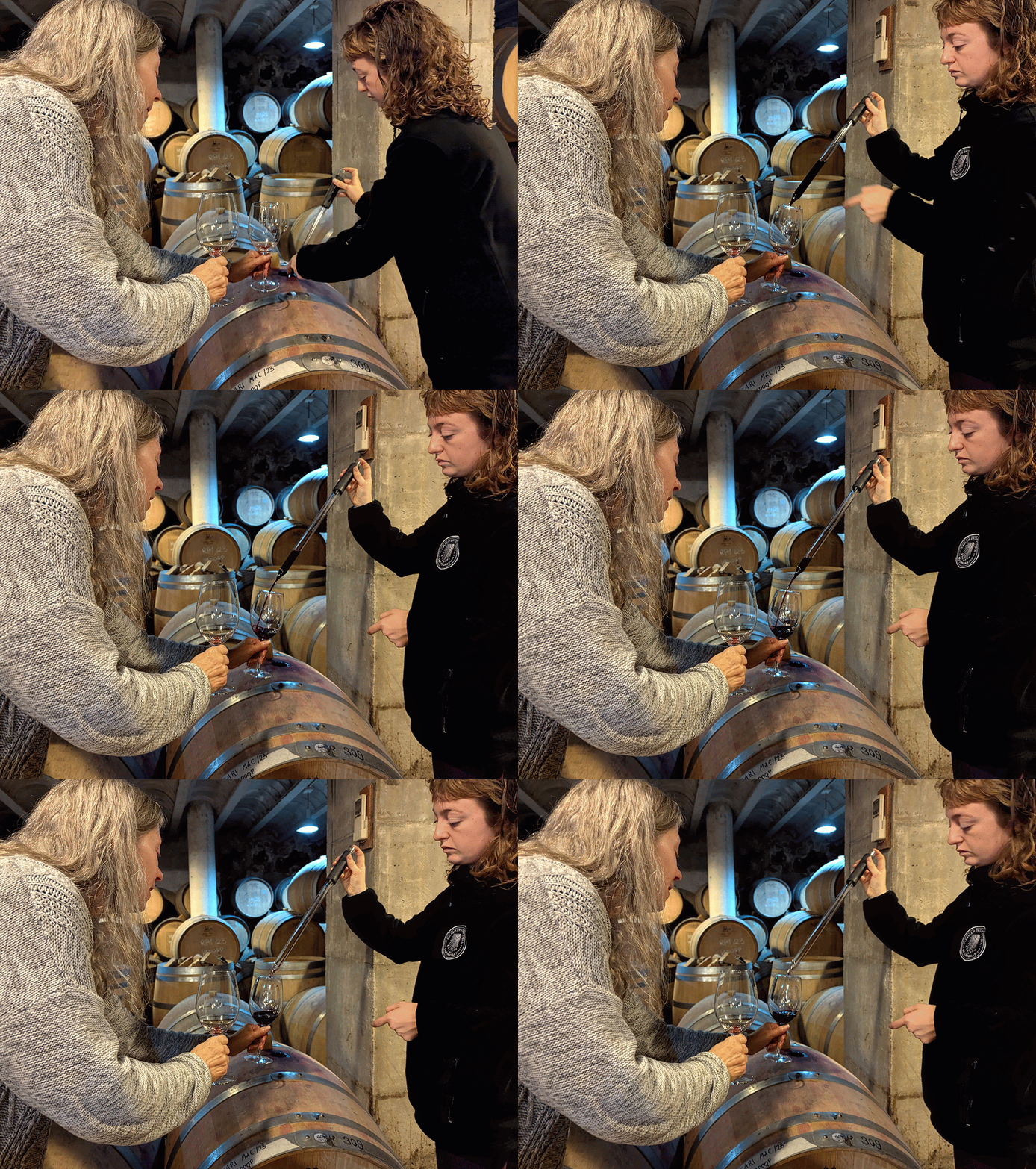
Special order reserve barrel
at Celler de L'Encastell.
Special order reserve barrel at Celler de L'Encastell
First time ever trying a
barrel tasting. This is
one way the maker decides
the wine is ready to bottle.
Barrel tasting at Celler de L'Encastell

Now, how to find this man we are supposed to meet? There were a few other people standing around, who appeared to be a couple tourists and a guide. They were, but he was not our guide - all of us were waiting for the winery tour guide, who appeared as we were chatting.

Instead of walking, as I had expected, he had us all squeeze into his truck and he headed up the steep, narrow streets. I was happy to not be driving.

At the winery up in the top of the town, we were met by his daughter, who has become the primary wine maker. She imparted a lot of information, but as a bonus, the other couple's guide was himself a winemaker. He was Irish but living and making wines in Spain, so we benefited from both the questions he asked and some of the deeper explanations he was able to give in English.

Despite the number of wine tours we have taken over the years, I still pick up new information at each one. The most important new tidbit here might be about free-run wine. Fermented must (grapes, seeds, pulp, skins, stems, and juice) is transferred to the press, and free run wine is the wine that just runs out from the weight of the must itself. It has the cleanest, clearest flavor.

The remaining solids are called pomace. Presses can be set to hold a certain PSI level and they will adjust to keep it steady as the juice is extracted and the pomace volume decreases.

Different wine makers will choose different maximum pressures. As the force goes up, the quality of the wine goes down, as it picks up higher concentrations from the skins and seeds, for example. But of course it gets more net volume from the grapes. So, a very cheap wine might come from a maker who uses higher pressure for extraction.

We were excited to get to taste the wines. They were just terrific. We even got to do a barrel tasting, something I had never done.

Clever introductory bites presentation at Brots
Clever introductory bites presentation at Brots.

Next, lunch: Brots in Poboleda, another Michelin restaurant in a small town. Take a look at their website, it's kinda' weird. The atmosphere and food are creative - and delicious. Of course we had to choose the tasting menu, which started with a playful charcuterie including olives loaded with droppers filled with balsamic vinegar. I remember some amazing goat cheese and grilled tuna. I do think there was one item I didn't care for, but even that (whatever is was) was still interesting to try. Would definitely go back.

After lunch, we hustled to a tasting at Cellers Scala Dei. This is the birthplace of Priorat. The prior of the Scala Dei monastery was the feudal lord, thus arose the name of the county. The monks were winemakers starting from the late 12th century.

In this tour, we got a close look at some of the grape handling equipment, such as a stemmer. This looks like a trough with a horizontal corkscrew running along the bottom. You would think that it would chop up all the grapes, but it is actually pretty gentle, pulling off the leaves and stems. The grapes are nicked just enough to let juice seep out when they are piled into the fermenting tanks.

We returned to the tasting room, where we were seated with another couple from the tour. We struck up converstation with "Weren't you guys at Brichs last night?" Yes, they were. We enjoyed their company (also from US but I forget where). Unfortunately, the wines presented in the tasting were not ones we prefer. I'd like to try more of their bolder reds next time.

The original plan had been to drive to a wine bar in Gratallops where we could get dinner and sample more Priorat wines. But as I said, we did not relish the idea of having more to drink and then driving these roads at night, so we went back to Falset the way we came. We took advantage of having an apartment, and shopped at the little grocery downstairs for bread, meat, cheese, fruit, etc. for dinner and stayed in and watched some college football. Under blankets in the chilly apartment, of course.

Sculptural Scala Dei logo Concrete tank at Scala Dei Barrel storage at Scala Dei Visiting Scala Dei:

Sculptural winery logo.

Concrete wine tank for aging without oak.

Barrels of different sizes impart different levels of oakiness.


Scala Dei - God's Ladder - gets its name from this mountain ridge.
Scala Dei mountain ridge

Sunday, October 27
An exciting time doing laundry

Our adventure was winding down, as we readied to return to Barcelona for our last few days. Naturally, we wanted to also take advantage of the washer and dryer in the apartment. We started a load of laundry to run while we munched on our leftover bread and cheese. Then we moved it to the dryer where we expected it to finish in plenty of time to pack and check out.

But oh, no! When I checked it, the clothes were hot and steamy. They even seemed more wet than when I had put them in - the dryer, or what we thought was a dryer, did seem to have a water tank, and my own dryer does steam (which I have never used). Maybe we had it on the wrong setting. The controls were all pictures so we searched online to figure out what they might mean, tried a different setting, and started again. No improvement.

Now we are starting to panic because we had to check out, and all our clothes are wet. So I head to the hotel lobby to ask about it. The lady at the desk says that the machine just heats the clothes. I ask why anyone would want that, and she says it is for line drying, because it is cold and damp there and they won't dry otherwise. So apparently, heat then hang then repeat until dry. Kind-of makes sense, as I did not see any dryer vent hose (though possibly it had one, not sure). She also wasn't 100% sure and said she would have it looked at. I can't find any information online related to such a thing, so I have no idea.

Anyway, she saved the day by taking my laundry into the hotel dryers and even folding it for us! She told us not to worry about the check-out time. Now that is some real customer service!

On to our couple-hours drive to Barcelona...

< Valencia Travel Site Home Spain / Portugal 2024 Home Barcelona II >