|
|
|
|
|
|
|
|
|
|
|
|
|
| Much of our drive up the Douro Valley looked like this: narrow, winding roads, lots of rockery, and views of the river and terraced vineyards. |
To save time in the morning we took the breakfast buffet at our hotel in Porto. It was reasonably good with enough variety, I thought, but a little pricey. We loaded up the car and headed out.
The Douro Valley is a steep river valley with winding roads. Our first scheduled wine tour was in Valdigem, near Peso da Regua. You can take a scenic route along the river to get there, but it took some manipulation to get the map directions to even plot it, as an unfavorable path that would take at least 3 hours. Instead, we followed the default map directions for the faster, but still scenic, northern route since we were running a little late.
We had rented the car and made our own tasting appointments to get some "authentic" experiences, and we succeeded. Our 1pm appointment at Quinta de Marrocos, one of the oldest wineries in the Douro region. We were met by the wine maker himself, César, who has been making wines there since 1979 on the multi-generational estate. He saw my husband's Seahawks cap, and told us that Rick Steves had visited him some 30 years ago, as the first quinta in Portugal to review (for those not from Pacific Northwest, the travel writer Rick Steves is a local celebrity). He knew of Steves's health issues and wished him well. Then he informed that it was time for a rest and asked us to come back in a couple hours.
|
|
| Courtyard of Quinta de Marrocos |
Luckily we were accepted early for our lunch reservation at Castas y Pratos. This restaurant and wine shop is in a long building with an open beam ceiling, next to the rail line in the town of Peso da Regua. There are other wine shops and tasting rooms there, so you probably could make a day of it right here.
Observation: Trains run the Douro Valley up to Pohinco, so you could make a day trip from Porto. The Douro has multiple dams with locks, so you can also take a Viking cruise all the way up to Vega de Terrón from where the river forms a border with Spain up to Salto de Castro. On teh Spanish side, it is called Ribera del Duero.
Again, I have already forgotten what we ate at Castas y Pratos (I really need to keep notes but it ruins the moment to do so). I think my husband had black pork with mushrooms and truffle and I'm pretty sure I had the almond crusted cod. In any case, it was delicious and the service was also terrific and friendly. Highly recommended.
Travel Tip: If you are a foodie traveling in Europe, check the Michelin Guide before you go. You will find amazing restaurants in the smallest of towns, and many of these will be very affordable, especially in comparison to US restaurants. You might notice most of my meal descriptions use words like delicious, fantastic, incredible, etc. The Michelin Guide is how we found a lot of these places. Some are even fairly casual, but you will probably want to make reservations at any of them.
After lunch we headed back to Quinta de Marrocos for our tour and tasting. César hosted us in his living room - it's unclear if that is truly his current living space or only an historical one. We were surrounded by old photos of the vineyards and his family. The site itself pre-dates the winery, as it was originally a Franciscan monastery that became a farm and a refuge for people being pushed out of Regua on the north of the river.
|
Left: Imagine the physical effort that goes into the vineyards in the Douro Valley!
Below: César Augusto Correia de Sequeira presenting his award winning bottles. |
|
|
|
|
César walked around the property to see the steep terraced hillsides and stone stairways, where even today all the labor is manual. He showed us through the rooms where the grapes are received and processed. As I said, the whole of the property is on steep hillsides, so the receiving rooms are built into the lower levels of the building and they utilize gravity to move the grapes and the juice. The crush is still done by foot, but of course all this work was completed before our October visit.
Observation: Crushing grapes by foot is still done. As César said, it looks nothing like when Lucy does it; it's quite slow and orderly, four people arm in arm, stepping gently with a stirring technique with their feet. The point is to release the juice without crushing the bitter seeds. I understand they do this in 4 hours shifts.
We passed through the wooden and ceramic tanks and on to the tasting room. We sampled table wines and ports. There is a limit on the amount of port that can be produced each season, and the excess wines were used for making brandy to fortify the ports. However, today, less expensive brandies are being imported and many Portuguese port makers have also starting producing table wines, and many of these are quite good. We came away with a few bottles, earmarking the Colheita vintage 2000 port for home - yes, we toted it in our luggage over the rest of our travels and today it is in our "cellar" (a walk-in closet in the basement) awaiting a special occasion to share it with friends.
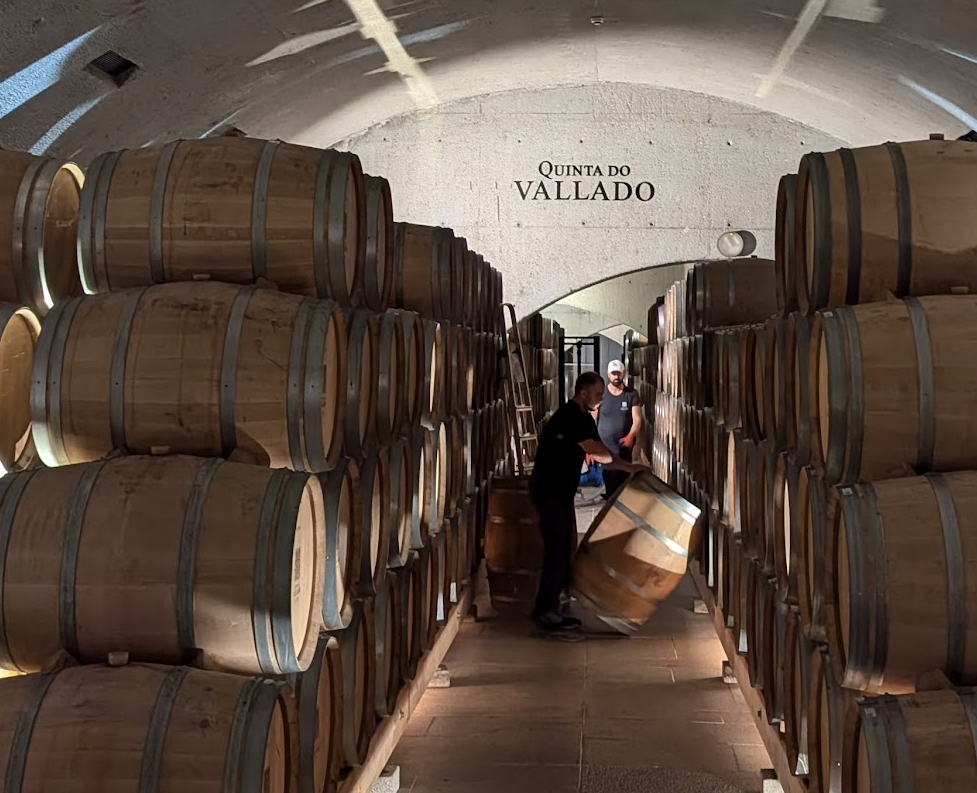
Our next tasting was across the river at Quinta do Vallado. We were a bit late due to our scheduling change and we had to join the group tour in progress. This winery is another of the oldest in the region but felt quite modern and commercial compared to Marrocos. It was a bigger operation and we saw many stainless steel tanks and mechanical stirrers as well as new and old barrels. We picked up a bottle here as well, to carry with us on our travels.
From there, we continued upriver some ways to our lodging, the Vila Gale Douro Vineyards. This place looks a lot nicer on the website than it turned out to be. In some ways it was awesome, and in others pretty terrible. We arrived in rainy darkness, to climb a switch-backing drive (only nearly ended in the actual vinyard once) to find the main entry building and get checked in.
|
|
The lodgings are in smaller buildings up and down the hillside, so we followed the instructions to where we were to park. Now the fun: hauling the luggage down 2 flights of wet, slate stairs to the room. The room itself was pretty nice, with a big, comfy bed and plenty of space for luggage. But we also found (the next night) a couple big bugs which we determined to be house centipedes, basically harmless and somewhat beneficial but not anything you want to find in your bed!
The website showed several restaurants but only the bar was open. There was on one else there so we sat in front of what we thought was a soccer match but was actually some show about the players (sure, that's beyond the hotel's control). We had some mediocre appetizers and a glass of their own Val Moreira wine, which was decent.
The morning greeted us with a lovely bright view and a rainbow. Our stay included breakfast, and the location is a bit remote, so we made our way again to the restaurant, about 6 flights down the hill. There are several swimming pools and places to explore. There were a surprising number of people at the breakfast - a pretty vast buffet - given how quiet it was the night before. We heard a variety of languages spoken and there were families with children as well as what looked like business travelers. It really is a beautiful location and would be a great place to come and stay for a family vacation, but if you have any difficulty getting around, you will need to coodinate your stay so that you can get a room close to your car and to the other amenities.
A Sphere photo of the morning view from our window at the Vila Gale Douro Vineyards. Click here
to see it in a Sphere viewer and move around in the space.
Our first wine tasting was set for 10:30 at Quinta do Portal. The driving time to Celeirós was supposed to be about 25 minutes but that must be according to local traffic data. The drive was narrow and twisty on a windy day, and I am sure I was driving slower than people who know the roads better. We were late for the tour, so we just started in on the tasting. The group - more Americans - joined at the next table after a bit and we struck up a little conversation. That's one thing that's fun about traveling.
Quinta do Portal is much newer than our previous wineries, operating since the 1990s, and they were in the initial group of winemakers believing that fine table wines could be made in Douro Valley alongside their famous ports. We liked their wines an bought a couple bottles.
|
|
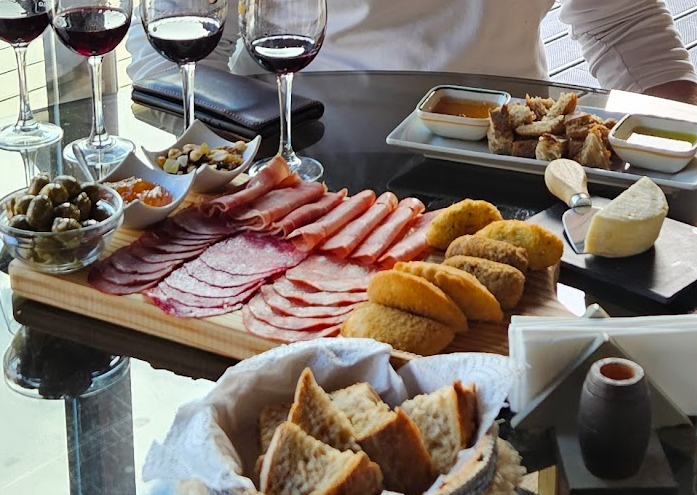
| Our very sharable lunch board. |
For our next tasting, we took a slightly different but equally scenic route back through Pinhão then started the steep climb to Qinta do Jalloto. We ended up on the craziest drive through the town, on one lane roads by parked cars and right up against houses. There were 3-point turns involved. But the map kept navigating and there was no way to turn around so we pressed on, finally arriving to a small building seemingly hanging off the side of the mountain.
Jalloto might have been one of the best overall tasting experiences: friendly hosts, jaw-dropping views, vibrant tasting room, bountiful meat and cheese platter, and of course the full-bodied wines. The tour guide at an adjacent table treated everyone to some live guitar music.
There was a couple at the next table whom we invited to help us eat our giant charcuterie, which included olive oil and honey also made on the estate. The were from Denmark and were backpacking around, without any fixed itinerary. They had hiked up from their hostel in town. They were doing basically the opposite of how we plan and travel. He said in years of traveling like this, the worst that had happened was that he got robbed once (which can happen even with the best plans) and one time he couldn't find any place to stay and had slept under a bridge. And these guys were probably older than we are, and they were dating, not even married. As an American this is so hard to wrap my head around but is inspiring at the same time. For the rest of our travels, any time our plans didn't play out as expected, we decided to be Danish for the day!
| A tour guide treated us to a little Enter Sandman. Just for fun, followed by some more traditional music of course. |
One topic among all the folks in the tasting room was how winding was the drive getting there. I was a little apprehensive about driving back after having some wine. We pointed the navigation back to the Pinhão riverside - and drove pretty directly to it. Only then we realized we must have taken a wrong turn on the way up because there was nothing difficult about it at all. And it wasn't just the liquid courage, I swear.
Travel Tip: Driving is not for everyone, especially mixed with wine. We were careful in our tastings, and sipping and spitting are quite acceptable. Alcohol limits are lower than some places in the US, but we saw a lot of wine tour vans in this area so you can certainly arrange not to drive when you go.
We wandered a bit around Pinhão and out to the waterfront but it was very windy, with a storm coming in. We ducked into the Quinta do Noval wine shop and tasting room to complete our tasting day. The woman working there was chatty in between being busy with restaurant wine pickups. We headed back to the Vila Gale to get ready for dinner.
|
|
| View of the Douro on the way back from Quinto do Jalloto. |
Our reservation was at the Bistro Terrace at the Quinta do Tedo. As the crow flies, it was right next to our hotel, but driving was another matter - down the curving drive from the top of the hill to the main road and bridge across the Rio Tedo where it meets the Douro, and then back up to the lodge. The restaurant focuses on traditional and seasonal menus. For mains, my husband had the wild boar loin with mushroom rice and said it was a great introduction to a regional pork dish. I had the pork tenderloin with chestnut and apple, and while the pork was excellent, I was disappointed in the side dish. I had in my mind something like sauteed diced fruit and nut but it was more of a puree and to me came off as a little mealy. Upon looking at the menu again, it was as described, and I think it was a matter of expectation and familiarity. The service was impeccable without feeling stuffy.
Another great day in the books! We have sampled wines from Douro's Baixo (lower) Corgo area from Porto to Peso de Regua, and Cima (upper) Corgo stretching upriver past Pinhão. In the morning we will head into Douro Superior. This region is higher, warmer, drier, and more remote. It sounded to me like it might have wines more similar to the bold Washington and Napa wines we enjoy so much at home.
After our breakfast, we hoisted our aptly-named luggage up the flights of stairs to our car and set on the road toward Douro Superior and our first stop, the Parque Arqueológico do Vale do Côa. The museum's founding resulted from community action following the discovery of ancient cave paintings and carvings in the Côa Valley. The impressive building houses displays not just about those, but about cave and other prehistoric art from around the world. We only had enough time to wander the museum and have lunch, but you could plan to make a day of it and use the hiking trails down to the river or take guided Jeep, walking, or kayak tours to view the art in person. The lunch was very enjoyable, by the way.
Panoramic view from the trails at the Parque Arqueológico do Vale do Côa. Click here
to see it in a Sphere viewer and move around in the space.
We continued our drive to - you guessed it - a wine tasting! We arrived at Quinta da Terrincha on a sunny but windy afternoon, to be greeted with lovely chilled and red wines and a luscious meat and cheese board. Our host described each taste as she poured, and then something truly remarkable happened: she left all the bottles on the table for us to revisit, or basically just drink as much as we wanted of them. It is probably a good thing that we had a prescribed time to meet our lodging host or we could certainly have made an evening of it.
|
|
Our table at Quinta da Terrincha. |
|
| Breakfast prepared by our host at Cantinho da Auzenda. | ||
| Wandering around Foz do Sabor. | ||
|
|
||
Instead, we settled up and made the short drive to Foz do Sabor, where we had reserved the Cantinho da Auzenda apartment. We were let in by the very friendly owner, with some gesturing to understand across our English and Spanish and her French. I was able to recall enough high school French to get much of what she was telling us, but not enough to reply in real time!
The apartment was equipped with a washer and the owner brought us a couple drying racks. Few people use clothes dryers in Portugal or Spain, from what we could tell. We put the racks outside in the breeze and brought them inside at dusk, and everything was mostly dry by the morning.
Travel Tip: On an extended trip, allocate time in your schedule for laundry, including drying time which might require overnight. We didn't realize this until pretty far into the planning but we managed to find some places with laundry on-site or nearby. We didn't really plan it as a needed activity, so sometimes we had to wedge it in or miss something else that we had wanted to do.
Foz do Sabor is a very small town. We walked around for a few blocks and that was pretty much the extent of it. It was dark and quiet overnight, once the bell from the church across the street stopped after 10pm. In the morning though, I heard a fair amount of traffic, so people are living there and communting to somewhere.
Our stay included a breakfast laid out for us in the refrigerator. We ate, used the tiny (but adequate) shower, and set off once again back toward the southwest and Lisbon.