| < Previous (San Sebastián) | Travel Site Home | France / Spain 2025 Home | Next (Los Picos and Las Arenas) > |
|
|
|
|
|
|
|
|
|
|
Itinerary
| Sun, Sept 21 | Sercotel Arenal Bilbao, Plaza Nuevo |
| Mon, Sept 22 | Guernica, Basque market, Parque de los Pueblos de Europa, Gaztelugatxe (aka Dragonstone), Restaurante Asador Portuando |
| Tues, Sept 23 | Extebarria Park, Nervión River walk, Guggenheim museum, Castaños, Biak Vinoteca, Areatza Park, Etxanobe |
| Wed, Sept 24 | Itsasmuseum, Parque de Doña Casilda, Azurmendi |
|
|
| View from our hotel room - the Teatro Arriaga Antzokia. |
For our drive from San Sebastián to Bilbao, our host at Pensión Koxka Bi had recommended we follow the coast for the views. We instead opted for the most direct route, as we have more coastal views coming up in our itinerary.
The drive was only about an hour and a half and was relatively uneventful until arriving at the hotel, Sercotel Arenal Bilbao. The parking for unloading was occupied so we pulled into the small street in front. The street turned out to be a pedestrian zone with no place to turn around.
Despite our very recent experience, I hopped out of the car to learn about where to park. While I was checking in, my husband had a little chat with a policeman. "Señor, señor, esté es un lugar para la gente caminar." "Lo siento, estoy perdido." Good thing he speaks some Spanish.
Bilbao, like San Sebastián, has huge underground parking topped with public squares, which seems the way to go for an urban area but maybe something difficult to retrofit into an existing city (although we know full well that these cities pre-date cars, so really it's about foresight and political will).
It was easy to find the parking entry and, importantly, to find the elevator up to ground level that was closest to the hotel. We did not have to wheel our bags too far and the plaza and sidewalks were reasonably smooth. We would be here for four nights with a planned laundry day, so we hauled all our luggage.
|
|
|
|
|
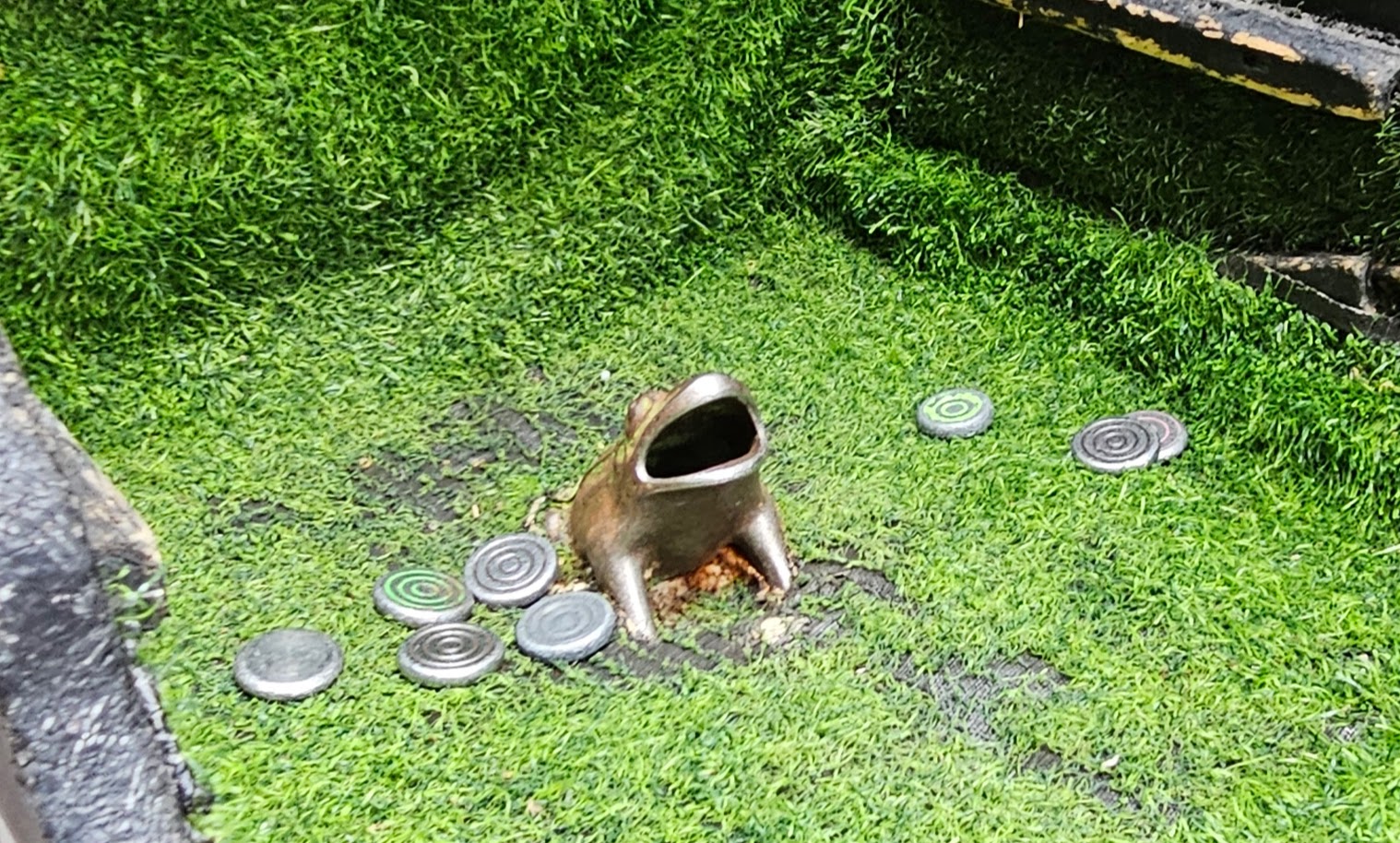
Bar game where you try to toss a token into a frog's mouth.
Mosaic tile street art. Maybe he is someone important. |
|
|
|
|
|
There was a lot of activity, including flags flying, ahead of the local
team soccer match.
Street art showing support for Palestine featuring a snippet from Picasso's Guernica. |
We were too early to check in, so we stashed our bags and headed to Plaza Nuevo for some pinxtos. At Urdiña Taberna, we thought we were getting small plates but they were more like raciones. We had fried calamari - battered, not breaded and quite good - would have made a great po' boy, stuffed red peppers advertised as meat filled but was more like the cheesy croquette filling with little bits of ground beef (good but too rich for what I expected), and maybe something else, I don't recall. The waiter was very friendly and supportive of our Spanish speaking efforts.
After lunch, we were able to get into our room and it was so nice, especially following our tiny pension in San Sebastian. Big, clean, AC, seating area, updated bathroom. They provided excellent service - we know because we the safe in the room had a secret feature and we had managed to lock ourselves out (ok, an unexpected feature, but surely not secret). Someone came within minutes to help us. We also asked for an ironing board and again, it arrived within minutes. There is a taxi stand right across the street, which we used a few times.
The hotel location was also great - right by the Old Town, the original Siete Calles (7 streets). After we settled in to our space, we headed back out to explore the Casco Viejo. We walked up and down looking for placards giving the history of these original streets' occupants.
|
|
|
The Catedral de Bilbao has a lot of beautiful stained glass, both traditional and with a more modern feel. |
|
|
|
|
We went inside the Catedral de Bilbao, or, Basilica of St. James. Note that in Spanish St. James is Santiago, and this basilica begun in the 14th century is a waypoint on the camino to Santiago de Compostela. We walked all around the inside, particularly admiring the stonework and stained glass.
Observation: The typical basilica layout has a central nave flanked by aisles, and frequently along the outsides of the aisles there will be chapels dedicated to saints and prayers. These often are sponsored by important families, possibly for their private use. So today when I am annoyed by extreme commercialism, I have to think back to the fact the naming rights have always been with us.
|
|
| The Iglesia de San Antón. |
The entry to the Bilbao Catedral was a two-fer with the Iglesia de San Antón, so we went there too. Though constructed after the Basilica of St. James, this structure had a harder life and seems older. Its location right along the river has suffered multiple floods and it was damaged in the Carlist wars. The site includes archeological discovery of old walls beneath the church, but the origin is uncertain.
At dinner time we returned to Plaza Nuevo for the restaurant Victor Montes. The front bar room was crowded with people enjoying pinxtos and we wondered if we were in the right place. But we were soon shown to a table in the dining room.
|
|
| Street scene in Bilbao's Casco Viejo. |
We started with mushroom and truffle croquettes. These were beautifully prepared but surprisingly, the inside had almost a gravy consistency. We also thought the same about the famous jamon croquettes. They are very popular but I guess we just don't like that style of croquette so much. The order included 6 and they were quite filling so we set them aside for the main courses of a beef stew and a pluma cut of pork. These were both very good. We also enjoyed a terrific bottle of Ribera del Duero wine.
We struck up conversation with a couple at the next table and talked about things we had in common, places we were going and had been. They were doing some traveling as well but returning to Bilbao for the flight home.One afternoon later that week, as we came downstairs from our room, there they were in the lobby booking the night before their flight. So, small world. We walked out together and had a drink before parting ways.
|
|
|
|
|
| We like doors. | |||
|
|
|
| In the Guernica market. | |
On this morning we set out on a driving tour. First stop was the town of Guernica, chosen both because its inspiration for Picasso's famous anti-war painting and because its Monday Market was said to be one of the best Basque markets around.
The drive was just over half an hour and we were easily able to follow signs to the market. But we ran into a snag on parking. There were spots on the street but it wasn't clear if we had to pay or not. Fortunately, a do-gooder stopped to explain what was needed and help us find the pay station.
|
|
| Sculpture outside the Guernica market. |
He left us there but must have still been close by. He returned when he saw we were still distressed. The pay station had failed to print the receipt. He walked us to a nearby town office where we were able to give the license plate and confirm the payment had been received. We didn't have a receipt in the windshield but in any case, we didn't have a parking ticket when we got back.
Travel Tip: In addition to taking pictures of your parking spots, also record your license plate if you have a rental car. This will save you countless returns to the car to get it in cases like this or registering for hotel parking.
He then appointed himself our tourguide, took us to the market (which I'm pretty sure knew where it was already) and told us of places we should go in town. Note that all of this was transacted in Spanish, so there was a fair amount of smiling and nodding on our part. From the reactions of some people who greeted him as we passed, I think he regularly adopts visitors like us. He did not ask for a tip or anything.
|
|
| The memorialized Guernica Oak, symbolizing Basque liberty, culture, and nationalism. |
We spent some time walking around the market and admiring the produce in particular. Basque people can be a bit insular and I don't think Guernica is much of a tourist destination, despite the famous name, and I feel like we were getting the side-eye a lot from the stall owners and patrons. I tried to be careful to keep people out of my pictures. We bought some bread and fruit for our breakfast.
Observation: The Basque people have a long history of civil liberties, including rights similar to habeas corpus dating to the mid-15th century. Governance was conducted publicly under oak trees which have been propagated over generations.
We picked up a walking tour of places before and after the 1937 bombings. Today we have many accounts of destruction in WWII, but the events in Guernica were the first, and viewed as experimental, carried out on such scale. The devastation had never been seen before and was a shocking outrage.
We followed the tour away from the market and up the hill, reading historical placards as we found them (the tour can be done in any order). We went inside the Pasealeku to see an air raid shelter.
We detoured into the Parque de los Pueblos de Europa y esculturas. The park has walking paths through wooded and open areas, a duck pond, and grand abstract sculptures. It also conveniently has water fountains and bathrooms.
|
|
|
|
| Roman amphitheater and tiled reproduction of Picasso's Guernica painting. |
Continuing along the street past the park we saw a black and white tiled mural of the famous work by Picasso. We noted several groups of guided tours so if you are a history buff, that would be a good thing to do.
We left Guernica and headed toward Mundaka, which is another of the European surfing capital. We were getting hungry so consulted the map for a restaurant along the way. The closest thing on the map was the Asador Portuondo. It looked like it was associated with a campground so we weren't sure what we would find.
There was a camp of sorts there, but as it turned out, there was also the Michelin-listed restaurant, and we were able to get a table. The dining room was upstairs, with a view of the Mundaka estuary. Sandbars form here, creating rapids for kayakers when the tide goes out.
I don't recall what we eat, but I am sure it was very good. I do remember having to stop myself from eating more of their bread.
We didn't try to find any surfers in Mundaka, but pressed on to our next site, the Gaztelugatxeko island in the Bay of Biscay. The island actually is connected by a stone causeway, but you have to hike down to the water and then climb back up to get there.
A hermitage dedicated to John the Baptist was constructed there in the 9th century. You wouldn't know it, but you might recognize the causeway and island as Dragonstone from Game of Thrones.
On a weekday in the fall, there was plenty of parking available. But also in the fall, a rainstorm was threatening. We chose to pass by the warnings against hiking in the wet and took our chances.
|
|
| Gaztelugatxeko causeway and hermitage. |
The walk started on a path that became more and more steep until it opened onto the causeway. Then after the cross, we got to climb back up, on steep stone stairs. The top treated us to views, quivery legs, and endorphins.
The walk back up the other side was even worse. It had become very windy and rain was threatening, but we made it back to the car as the drops started to fall.
We headed back to Bilbao and a shower and rest, then walked out for, you guessed it, pinxtos for dinner. And we couldn't resist the Basque Cheesecake carryout as we walked back to the room. It was good, but not as good as the memorable cheese tart we had in Lisbon.
|
Dinner of champions: Pinxtos, wine, and cheesecake. |
|
|
|
|
||
|
|
| Bilbao view from Extebarria park. This is a regular photo, not a paroramic view. |
Today we were looking forward to our visit to the Guggenheim museum. But first, fueled by leftover cheesecake, we began with a hill climb up to the viewpoints in Extebarria park, just a couple blocks from our hotel.
It was raining and not especially pleasant but the hike soon warmed us up. The crest of the park looks back down a valley across the city, but the distant hills were occluded by misty clouds.
Still, it was a good way to get some exercise and we saw some other people out doing the same.
We descended the hill, crossed the river, and followed the waterside walkway, and made the 20-minute walk to the Guggenheim. The walkway is wide and features statues and sculptures every so often.
|
|
| Bilbao City Hall from across the river. |
I don't recall whether or not we bought tickets in advance, but if we did, it was just before. Our visit, by to the original plan, would have been Monday. We swapped ininerary days, possibly due to weather forecast, so we must not have bought the tickets before our trip.
Travel Tip: When you tuck your lightweight travel umbrella (you have one, right?) into your pack at the start of your day, also add some plastic bags. You will want it to stow your wet umbrella when you go indoors or when the sun comes out.
The entry plaza outside the museum is the home of Puppy, Jeff Koons's living garden of a terrier. Sadly, it was covered in scaffolding while all the plants were being swapped out. This is done once (or twice?) a year and takes a team of workers more than three days.
|
|
| Guggenheim entry and Puppy sculpture surrounded by scaffolding. You can get an idea of its size and why it takes so long to refresh the plantings. |
Of course the Guggenheim's architecture is famously recognizable. But I hadn't given much thought to what sort of museum it would be.
As it turned out, its exhiits were uniquely surprising and thought provoking, and not necessarily what might come to mind when you think of art.
Just past the entry is an enormous room with tall, metal, sculptural walls. This was The Matter of Time by Richard Sera. It seemed grand but honestly not that impressive - until we began the experiences designed by the artist.
The groupings of sculpture are meant to be walked through. You move through spaces that enclose, open, lean in and lean out. They affect your perceptions and emotions in surprising ways.
A set might look like "more of the same" as the others, but each one pushes you slightly differently. Cozy, curious, dizzy, expansive, unbalanced, anxious, relieved. I actually felt I needed to regroup a bit from the experience (not in an unpleasant way) before exiting to the rest of the museum.
|
|
| Richard Sera's sculpture, A Matter of Time, as we later saw from above. |
We wandered through galleries of paintings and scultpures, then into a darkened multimedia room of upholstered benches and screens on three walls. This was Sky Hopinka's Fainting Spells, the Indian Pipe plant's lore in Native American cultures told through imagery, music, and poetry. It was enchanting but hard to follow. I would consider it akin to multimedia impressionism in the way it imparted more feeling than thought. Fortunately, the poem was posted in various languages in the hall outside.
Upstairs we found rooms full of Another Day. Another Night. by Barbara Kruger. Her bold, text-heavy graphics use geometry and color to effectively visualize poetry. Themes are politically, culturally, and technologically current, evoking discomfort, outrage, and despair. But there are still messages of kindness and hope embedded.
|
|
|
Parts of three Barbara Kruger exhibits. Note the grand scale. |
|
|
||
I could have spent a lot more time in the Kruger rooms, reading every word and then letting the ideas soak in. Her work seemed to occupy the entire floor. But my vision was not cooperating well and it was taking too long, and there was more to see.
Overall I would rate the Guggenheim as superior. The Guggenheim has huge, dramatic spaces filled with huge, dramatic art. The building itself is art. And what is art if not storytelling that affects you, makes you aware of yourself through the things that make you feel uncomfortable, comforted, angry, sad, joyful, hopeful? This was my experience in the Guggenheim that day.
|
|
|
|
|
| Some of the sculptures around the outside of the Guggenheim. | |||
Outside, we walked around the building to view more sculptures and to admire the architecture. We climbed the adjacent tower to cross the Puente de la Salve into the Castaña neighborhood. We had planned to take the funicular up to a viewpoint but decided we were more interested in lunch at the moment.
|
|
| Castaña street. Murals of chestnuts, or castañas, adorn the walls. |
We got our lunch at Biak Vinoteca, sitting at the counter. Yes, pinxtos again! Never gets old, as they are different everywhere. But I would also say that the platos at the table behind us also looked terrific.
|
|
| Pinxto with roasted red pepper and boiled egg. |
|
|
| Memorial to Basque sailors, in Begoña neighborhood. |
We strolled through the neighborhood and came out in Areatza Park along the opposite side of the river as our morning walk. This route also had public art. We got back to the room and collected our laundry and went to a nearby laundromat.
After a rest and a clean-up, we took a cab out to Etxanobe for dinner. This Michelin-listed restaurant occupies a very cool space and has gracious yet friendly service. We did the tasting menu with wine pairings, but I didn't make any notes or take pictures.
We recall finding the food good but not amazing, maybe a little busy with too much going on. If you are thinking of going there, I would not discourage you as I don't recall well enough to be trusted on this.
We decided to walk back - the restaurant was about halfway along our earlier walk to the Guggenheim. We stopped in to a bar to grab a drink. We were sharing the crowded space with an American who was a pilot whose airline had something like twice weekly flights to Bilbao.
His schedule had him arrive, stay three nights or so, then fly back. He had done it so many times he didn't even bother with tourism and this was his local haunt. His co-pilot, though, was who knows where, with instructions to be on time for the outbound flight.
The plane, he said, flew on its next leg to wherever else it went. He told us they try to never fully shut down the planes because that is when things break, when the systems are starting up.
|
|
| PostBy.me mailbox and rack of postcards. |
Before setting out this morning, we stopped in one of the tourist shops near the hotel. My father had recently moved into an assisted living center and was no longer reading email, so we wanted to send a postcard.
We weren't too surprised when we asked about stamps and they had them there at the shop, as we are used to buying them in the grocery. But what was surprising, and cool, was that there was a drop box for them right outside. PostBy.me is an intermediary company that makes sending mail easy for tourists. Kinda' cool idea.
|
|
|
| Along the walk: Iglesia de San José de la Montaña viewed from the plaza and Sacred Heart of Jesus monument near the Itsasmuseum. | |
Our destination for the morning was the Itsasmuseum of Bilbao and Biscay maritime history. To get there, we crossed the river and walked through the Abando and Indautxu neighborhoods.
We crossed the Plaza de Don Federico Moyúa, a meeting of eight streets at a broad traffic circle containing a fountain and thick beds of impatiens in bloom. The air was a bit chilly but plenty of people were enjoying the sunshine. We spotted a cafe and walked in, but stopped short when we saw the receptionist for a bank.
We had entered a Santander Work Café. But it was open to the public so we grabbed some coffee, tea, and some kind of breakfast from the counter and watched people some in out for banking while we ate.
|
|
| Enormous chain on maritime museum plaza. There were lines of anchors along the walls - you can see a few in the background. |
The Basque mariners dominated the whaling and cod fishing industries for centuries. Their innovation in ship building, including for whaling, fishing, and cargo, made them key contributors to Spain's economic and military strength during the Age of Discovery.
Because they had discovered cod fishing grounds far into the North Atlantic, there are claims that Basque people were on the American coasts before Columbus. There seems to be no proof of this, but fishermen are known for keeping their secrets.
But researching this just now, I found that Columbus's Santa Maris was owned and operated and the Niña crewed by Basques, so at the very least they arrived alongside him.
|
|
| There were many intricate ship models and replicas throughout the museum. |
One of the cultural elements we learned at the museum involves women's rights. While the men were seafarers, the women were left to run the towns and businesses. They had rights of property ownership and inheritance beyond those seen elsewhere in Europe.
The museum includes sections on the marine environment and on modern ship building and industry as well.
|
|
| Fresh fish in the window of a shop we passed. The percebe, with the blue background, are barnacles. These are dangerous to harvest and, as you can see, much more expensive than the fish. Despite my efforts, I have yet to try them. |
We walked back to the hotel through Parque de Doña Casilda. This section of the city is flat, and you can look down a staight vista to see monuments and fountains. We admired the playing water in front of the pergola, skirted the duck pond, and continued on our way.
Observation: Nearly everywhere we have been in Spain has been very clean. There is a lot of street art, much of which would be classified as graffiti. Bilboa seemed to have even less grafitti than other Spanish cities. I wish Americans would take more pride in keeping things cleaned up. Sigh.
We followed the street a block to the north of our outbound walk, past the Iglesia de San Jose de la Montaña. This area is not very touristy. There are apartments, offices, and shops geared at people living here. As usual, it was quite clean.
Now for the Big Event! This was one of the highlights of the trip, and possibly also the most expensive thing we did. And it was worth it. We had lunch at Azurmendi.
This restaurant with three Michelin stars was about 20 minutes out of the city, so we grabbed a cab. It's not far off the highway but it's on this sort of nondescript road that feels in the middle of nowhere. Don't let that fool you.
I am not a a blogger, not an influencer, not one to take pictures of my food (except sometimes on these trips). I took a picture of. every. course. And I wrote up notes that night so I wouldn't forget it. I probably still have forgotten something, but here goes.
This might be the most amazing dining experience I have ever had.
Just past the reception was a forest room, with an entire wall of plants fronted by seats and low tables. Here we were presented with glasses of crisp Txocholi wine, much nicer than we had been having in the pinxto bars and even some nicer restaurants, and a picnic basket. Our host, one of the chefs, explained each element and the order in which to enjoy them, then left us to it.
|
|
|
| Forest room / foyer and welcome picnic. |
Our chef-guide returned to lead us into the kitchen where all chefs greeted us with a chorus of "Kaixo", Basque for hello. Here was laid a table from the sea, and a couple chefs were pouring water onto dry ice to make a sea fog. We sampled:
|
|
|
| Bounty from the sea. |
From the kitchen, we were led to the Garden as the goodbyes from the chefs echoed behind us (we think they said On Egin, meaning enjoy your meal). We entered a room decorated with recycled oak and flowers made from the dried lime rinds that are residual from the kitchen (the restaurant also had a sign pointing to its "sustainability center" but we did not get a chance to visit it). In this enchanting room, all of our bites were also disguised as flowers.
|
|
|
|
|
|
||
| Tastes in the Garden room. | ||
We had just eaten 12 dishes, albeit small, and this was lunchtime. So I expected a "'kay, thanks, bye" but next we were delivered by our host chef into the actual dining room. Now, bear in mind that we have seen no other patrons at all up until this point. We felt like the only people there.
|
|
| The first dining course. |
In contrast, the dining room was full of people at large tables, generously spaced. The experience thus far made us feel the center of the world. The service in the dining room, though we now had to share it with other people, continued to be top-notch.
We were offered our choice(s) of 2 champagnes, their spin on the marianito, and a non-alcoholic concoction. We had a champagne (not wonderful) and the marianito, which was delicious but started to go to my head too much so I had to set it aside for a bit.
More courses: a mushroom course, again with instructions on the order in which to enjoy:
From here, we were ready for white wine and there was a little goof. We had earlier asked about a chablis, but when the time came, we were poured a white burgundy. We accepted it, in fact I don't think we mentioned it, and it was a fine accompaniment.
From the Larder:
|
|
|
|
|
| Feast from the Larder. | |||
Even though we had had so much from the sea already, the next part of the menu was actually labeled The Sea.
|
|
|
| Drawn from the Sea. | |
Next, The Field. For this we asked for a full-bodied red and we received a wonderful temperanillo from Bodegas Roda, the Roda I. It was right up our alley and we learned that it was from Rioja Alta so we will certainly check this out. We found their tasting room in Haro so we might be able to visit there later in this trip (sadly, that did not happen). Now, the food:
|
|
|
| Provided by the Field. | |
After this, we did move on to desserts.
|
|
|
|
|
| Finishing with desserts. | |||
Even though I mention a couple small flubs, let me be clear that overall was fantastic experience.
When we arrived, they inquired if they should call a taxi for us to return, so that we wouldn't have to wait so long. The host chef seemed genuinely delighted by our delight. My purse and umbrella, which were collected on arrival, were thoughtfully waiting on a stool at the table when we reached the dining room. My water glass was never empty. As soon as I rose from the table, someone was there to assist me to find the bathroom, and when I returned, someone deftly pulled my chair to seat me and I had received a new napkin. The chef - I believe it was Eneko Atxa himself - visited each table. He wasn't haughty or instrusive, just wanted to make sure we were enjoying ourselves.
Each course was an enchantment of flavors, colors, and textures.
Also of note is that the restaurant has a living shoot from the Guernica oak that we had learned about a couple days ago. Their philosophy centers on cooking sustainably to nurture the health of people and communities.
More to come...
Return to top