Santiago de Compostela, A Coruña, Galicia, Spain
September 2025

Flag of Spain (from Wikipedia) Camino marker Spires of the church of San Francisco Santiago de Compostela coat of arms (from Wikipedia) Santiago de Compostela flag (from Wikipedia) Wall sign for pilgrims Front of Igrexa de San Francisco Galicia coat of arms (from Wikipedia) Flag of Galicia (from Wikipedia)

Itinerary

Sun, Sept 28 Altair Hotel, Herver e Fervor, Cathedral of Santiago de Compostela, Terraza-Bar at Hotel Costa Vella, El Papatorio
Mon, Sept 29 Monte Pedroso, Parque do Carme do Abaixo, Parque da Alameda, Museo de Pobo Galego (Museum of the Galician People), ANACO.
Tue, Sept 30 Mercado de Abastos, Museo do Pobo Galego, Restaurante Montoto, A Horta d'Obradoiro
Wed, Oct 1 Altair Hotel, departure

Sunday, September 28
Altair Hotel, Herver e Fervor, Cathedral of Santiago de Compostela, Terraza-Bar at Hotel Costa Vella, El Papatorio

Brass scallop shell inset into wall
Brass scallop shell inset into a wall in Santiago de Compostela marks the end of pilgrims' journeys.

After our walk along the beach trail in Barreiros, we packed up and hit the road. I had planned a couple other stops for sights along the coast, including the Faro de Estaca (Estaca de Bares lighthouse) and a walk out to the northernmost point of the Iberian peninsula. But after a few days of driving with short hotel stays, we were anxious to press on to our destination.

Travel Tip: It might be fun to pick a theme for traveling. We had already happened to visit other superlative locations - southernmost house in Key West, westernmost point of continental Europe in Portugal, etc. So now we like to visit these when we have the chance. We also seem to find places with a connection to Ernest Hemingway.

The drive westward crosses the Cantabrian mountains. We hit a dense fog. I really like how Spain manages driving hazards. In cases like this or where there are steep grades, electronic billboards indicate the distance cars should maintain for safety, before the hazard is encountered.

And I guess people are better at obeying them than in the US. We did not encroach on any car ahead, nor did we have anyone speeding up behind us. We noted previously how people put on their blinkers when there is an unexpected slowdown, heavy rain, etc. We have started doing that at home now too.

In Santiago de Compostela, we had booked the Altair Hotel and we carefully followed their directions to the closest parking garage. We had learned to advance scout the situation on the map and we were improving; we only drove by it once before deciding it was the right place.

Tasty tacos Raviolis in sauce Guaguancó beer label
Delicious tacos and ravioli with a refreshing local beer from Hervor e Fervor.

We walked the couple blocks to the hotel, rolling our luggage. Fortunately the sidewalks were smooth so we didn't make the clack-clack-clack you do on cobblestones.

On the Sunday we arrived, there was some street parking in front of the hotel so we could have unloaded there. But the walk was not bad.

The Altair was probably one of my favorite hotels on our trip. The room was updated with contemporary styling but still had a historic, cozy feel. We had space for our things. And it was so nice to have a big, modern bathroom.

The staff were terrific as well, very hard working. It seemed like the same two ladies were almost always there. They were friendly and helpful. We shared some good conversations in Spanish.

The location was also just right for us. We were just minutes away from the very touristy Casco Viejo (old town) surrounding the camino-destination cathedral. Many streets in that area are pedestrian-only, with bollards that are lowered to allow deliveries and other traffic only during certain hours.

But the Casco Viejo is also quite crowded, and we were away from that. We did have some street (and bird) noise in the mornings, but it was quiet overnight.

Travel Tip: There are streets that are pedestrian and are blocked by bollards, but these are opened during the workdays. You have to pay attention walking, and conversely, you might not be able to drive when you had planned to.

After we unpacked, we set out for some lunch. We were very hungry, so we took the closest spot that was open, a taco restaurant right around the corner.

And boy were we glad we did. The food at Hervor e Fervor was delicious. I even took pictures! Crazy good tacos and some squid-ink (?) pasta raviolis in sauce. With refreshing local beer.

Church of San Francisco
Church of San Francisco.
North side of the Cathedral.
North side of the Cathedral
The enticing gate to the Terraza at the Costa Vella hotel.
Garden of the Terraza at the Costa Vella hotel

Since we got into town earlier than we had planned, we decided to head on down to Casco Viejo. We passed by the Church of San Francisco, which we mistook for the Monastery of San Martiño de Pinario, which we planned to visit another day.

We continued our walk and did come to the Monastery, which shares a plaza with the north side of the Cathedral of Santiago de Compostela. This is not the location of the tour entry, however.

Altar and organs of the Cathedral of Santiago de Compostela
The ornate altar of the Cathedral of Santiago de Compostela. On the side walls you can see organ pipes. Note the rope hanging in the center - it holds a censer, the botafumeiro, and you can see it go up to a pulley and then down to a column where it is tied off.

We followed around the building to find the destination of pilgrims making the camino from starting points in France, Spain, or Portugal. There was a surprisingly short line to get in, so in we went.

We walked about, taking pictures. The altar is one of the more ornate that we have seen, but other parts of the interior are remarkably simple and calm.

On one side of the altar we encountered the real line - people waiting for a walk that descends into the crypt of St. James then threads up behind the altar to view some other relics (not sure exactly what, since we didn't go). We took a pass on that but still saw some beautiful things.

The whole of the old town was full of people in trail clothes, with full backpacks and hiking poles. Many had knee braces, bandaged toes peeking through sandals, were limping, or otherwise showing wear and tear from their walk. But most had a triumphant (and relieved) air.

People of all ages walk the trail, for religious or other reasons. Many people we chatted with during our stay were in their 70s and had made the trek more than once.

One walker who trekked from Lisbon said it was much harder than coming from St. Jean in France. We talked with people from the US, Canada, Germany, England, and New Zealand.

We made the circuit around the Casco Viejo and walked back to the hotel past the garage where we had parked. Looking for refreshment, we found the terraza at the Costa Vella hotel.

The garden entices you past the gate, and we were happy they had a table available. But it was... odd. From the outset, the waiter seemed annoyed we were there. He was brusque almost to the point of rudeness.

We each got a glass of wine, which was just fair. But then the waiter never came back by to see if we wanted anything else. I think we even had to walk inside to pay so that we could leave.

At dinner time, we wandered back down the hill into Casco Viejo. It was a Sunday so many shops were closed. But we managed to find a tourism shop and bought a bottle (Lobarzán, of mencía, araúxa, and bastardo grapes) and asked for recommendations for tapas.

All of her recommendations were full, but finally at one, El Papatorio, we were able to get a table outside. It was a little cool and breezy but we were willing to take it.

As we entered, we saw a case of meats and passed by charcoal grills where meat was being moved along from one temperature coals to another. We had a feeling this was going to be good. We shared a chuletón - ribeye - with wonderful fried potato chunks and grilled vegetables.

Travel Tip: In the Casco Viejo you will want dining reservations, probably even for lunch, even in the shoulder season. While you can find a meal, it might not be what you had in mind.

Satisfied with our dinner, we toted our purchased wine back to the room. We were grateful for the space after our previous night's cramped quarters, and were also happy that we would be staying in one place for the next few nights.

More sights from our first day's walk around town.

Return to top

Monday, September 29
Adèlia Café, Monte Pedroso, Parque do Carme do Abaixo, Parque da Alameda, Museo de Pobo Galego (Museum of the Galician People), ANACO.

Mural with ladies and pile of laundry A mural along our walk. Are those laundry fairies? A cross along the path to Monte Pedroso
Still climbing, with the peak in sight.
Communications towers and large Christian monument atop Monte Pedroso
Panoramic view of Santiago de Compostela from Monte Pedroso.
Communications towers and large Christian monument atop Monte Pedroso, from which you can look back at Santiago de Compostela and beyond.

In the morning, we were surprised at how dark it was when we got up. Spain follows Central European Time, and by now we had come to the western reaches of it, putting the sun about an hour behind what we expected.

We were also up a little early, maybe. We walked out in search of breakfast or at least coffee and tea. There was surprisingly little available near the hotel (which has a breakfast, if you order it the evening ahead). We found one place that didn't open until 9:30. But it got to be that time and we hadn't found anything else, so we went back.

We were at the Adèlia Café, which was just what we wanted. Great choices for coffee and tea, plus a fresh and healthy breakfast menu. Avocado toast, anyone?

We had to fuel up for a morning hike. We were going out of the town and up to see the view from Monte Pedroso.

Setting out on foot from the hotel, we took a few turns, not completely convinced we were right but following the map directions. Just past the stadium on Rúa do Campo de Santa Isabel, the road started climbing. We followed the street along the east side of Parque do Monte Pío, then continued straight onto Rúa das Casa Novas, to its end at a trailhead.

Observation: You might wonder why the street names don't seem to be in Spanish. That's because we were in Galicia, which has its own language, as do the Basque Country, Catalonia, and Val d'Aran autonomous regions of Spain.

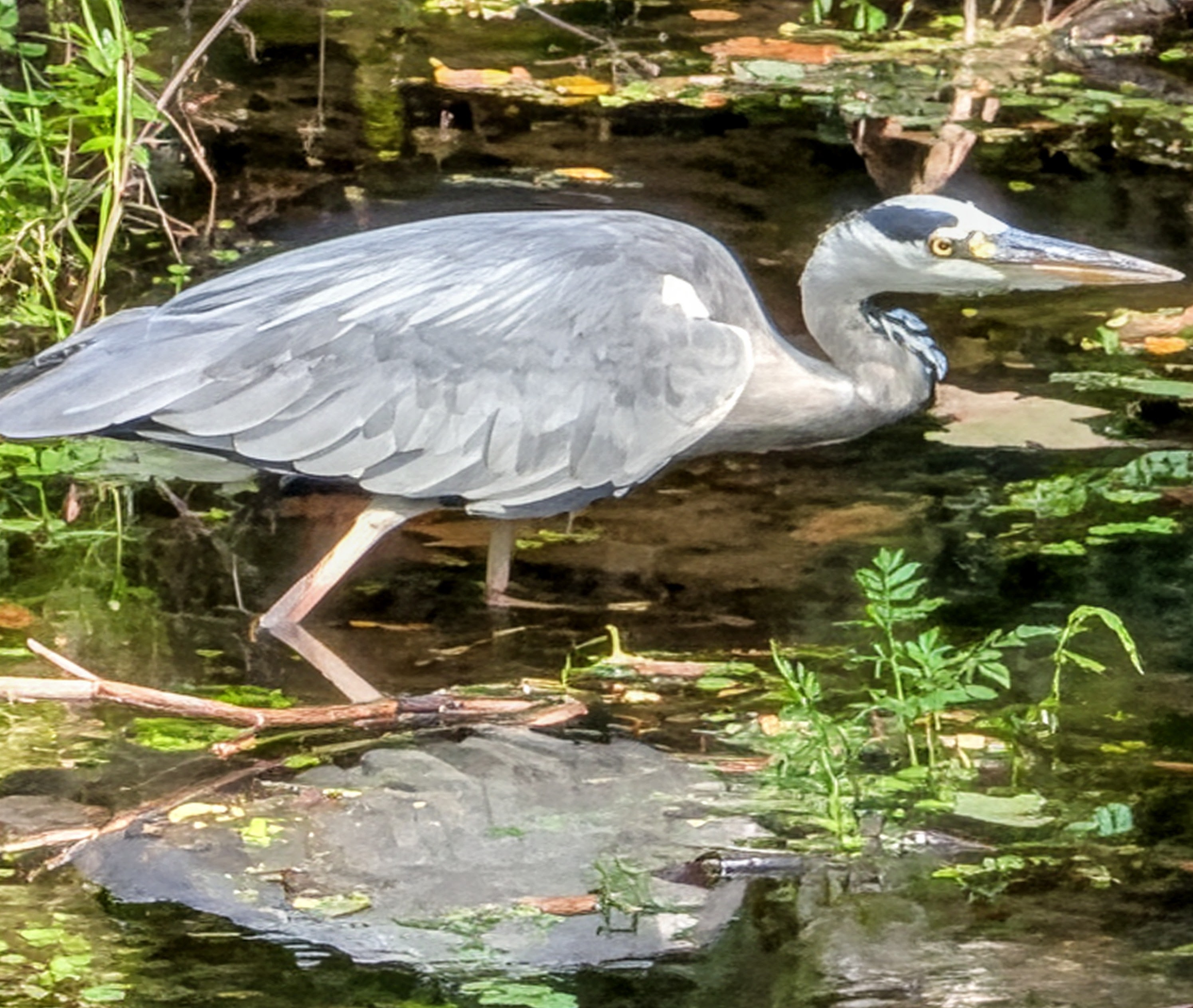
Bird and its reflection
Had to zoom in to snap this bird and its reflection in the Sarela River.
Message in restaurant
From our lunch spot: Traveler, there is no path; the path is made by walking.
Wine label from Trebón
Galician wine we enjoyed at ANACO.

So far we had walked a mile and a half and climbed 300 feet. We had another mile and about 500 feet still to climb. It was warm and we were glad to have gotten a reasonably early start.

At the top are some giant radio and TV communications towers and offices, along with a monument with cross and a nice overlook. I also read that there are some petroglyphs but we did not go find them.

On the return, we considered following a different path down but thought it best to follow our footsteps. Soon the trail looked unfamiliar and we decided we had missed a turn. We still managed to come back to the same streets, so we weren't terribly lost.

We skirted the west side of Parque do Monte Pío this time, to hike down the narrow Rúa de Carme de Abaixo. We detoured to cross the footbridge over the Sarela River. I thought I had seen that it was supposed to bring luck or love or something.

I didn't locate that information just now, so maybe I imagined it. I did just find a site describing a hike along the river, which maybe we can do on our next visit.

We walked around and through Parque da Alameda, with its trees, wide paths, gardens, and statues, and vistas. There were plenty of people out enjoying the day.

Beer can label showing how to separate the cans from the 6-pack
No plastic rings! Beer packs are stuck together with tacky gel. Ingenious!.

The wooded park is laid out around a hill. One side drops away from a balcony aligned with the formal layout entering the main campus (I assume) of the University of Santiago de Compostela.

By now we were ready to eat! But we were in Casco Viejo and everywhere was crowded. We finally found a little spot that was empty-ish, with a friendly lady working the counter. It didn't have exactly the food we were looking for, but we got a snack and some beers and were content enough.

We had time to kill before dinner so we meandered the streets, passing the university library and back along the plaza in front of the cathedral. It was a beautiful afternoon and the plaza was strewn with newly-arrived walkers. Some seemed to be having a nap in the sun, right on the pavement.

We got back to the room in time to clean up and have a little rest. I have an eye dryness condition that was troublesome, affecting both vision and comfort. One of the treatments is a moist-heat eye mask that is warmed in the microwave oven. So in most of our hotels, I had been taking it to the front desk and awkwardly asking to have it heated.

I continued doing this at the Altair. As we had stayed a few days and mostly saw and chatted with the same two hard-working ladies, the lady at the desk asked me about it. We had a nice conversation in Spanish in which she told me her father also had these eye issues. It made the situation feel less embarrassing to me.

Later, we walked back out for our dinner at ANACO. The only picture I took was of the wine bottle, and I didn't make any notes about our meal. My recollection, though, was that everything was very good and the service was gracious and well-timed. Maybe you will take that as a recommendation, and maybe I will go back someday.

More sights from our day:
Sculpture in Alameda Park; Archbishop Alonso de Fonseca looking weary from scholarship;
the Cathedral with pilgrims triumphant and / or resting on the plaza; a pilgrim sculpture that is also a souvenir machine..
Flat metal sculpture of men walking, Alameda Park Statue of Archbishop Alonso de Fonseca Cathedral of Santiago de Compostela with wearing pilgrims resting on plaza Pilgrim scuplture souvenir machine

Return to top

Tuesday, September 30
Mercado de Abastos, Museo do Pobo Galego, Restaurante Montoto, A Horta d'Obradoiro

Relief sculpture of fish at the market Relief sculpture of cow, calf, and horse at the market
Cafe Dromedario-branded Biscoff
One of the basilica-style buildings of the Mercado de Abastos
At the market: sculptures indicating what is in the buildings; Café Dromedary (coffee company) branded Biscoff on Estrella beer table; western-most building of the market.

Our morning plan was to visit the Mercado de Abastos and check out the local food and activity. We assumed we would be able to get some breakfast at different food stalls, but it seemed to be more of an actual grocery market than prepared foods.

We may have been early, which is unusual for us. Or, for me, more specifically since I am not really a morning person. We did find a coffee counter that was setting up, so we got our morning tea and coffee and some Biscoff, gratis.

Culture and arts complex in the distance from near the market
Another destination for our next visit: the modern Cidade da Cultura de Galicia culture and arts center, rising from the hillside as seen from near the market.

The market is impressive, comprising several long, basilica-style buildings. Relief sculptures on the end walls indicate what foods were historically available in each structure. It was full of people working quite seriously, offering fresh seafood, meats, vegetables, and more.

We found a bakery stall and got some bread, then sat on a bench outside to eat it and to watch people set up produce tables. They had some heavy umbrellas to deal with, for shade in the already strengthening sun. We did a little shopping in the stores along the side of the market, and I found some earrings in a jewelry shop that had good prices.

Next we headed to the Museo de Pobo Galego, the museum of the Galician People, which documents and celebrates the regional culture and artisanry. Like the Basque museum, it opens with seafaring. It progresses through agriculture, weaving, costume, civic life, and more, from historical through more modern times.

There are also archaeological exhibits. Galicia, and the north of Spain and into Portugal, is dotted with castros. The fortified hilltop villages of Celtic roots dating from the 4th century BC left behind stone foundations of huts and town walls. Visiting one would also be on the list of things to do on the next trip.

The museum is in an old convent, and the chapel remains. But the most impressive feature is the triple-spiral staircase. Three staircases ascend a tower and open landings to different doors and levels. I think we spent as much time admiring this as we did any other exhibit.

Base of triple-spiral staircase Looking up the spiral staircase Looking across the triple spiral staircase
Stand with your feet on the spot... ...and look up to see this. From mid-way up, you can see one landing.

From the museum we headed away from the old town and into a more modern street, looking for lunch. We grabbed an outside table at Restaurante Montoto. I don't recall too much about the food. We did enjoy people-watching on the street.

Now it was time to do our laundry. There was one, Lavandaria da Troia, not too far from the hotel. The small lobby was full of hikers, swapping stories. Some had done it multiple times. One told us of bringing a partner who wouldn't eat or care for himself properly and ran into problems. The camaraderie reminded me of that of Appalachian Trail hikers, or Grateful Dead concert followers.

By the time we left with our bag of clean and folded clothes, we were convinced that walking the camino was something that we could and should do. My passion for trying it has cooled a bit, thankfully.

Bell towers of Igrexa de San Francisco in the sunset
Galician flag for independence Bell towers of Igrexa de San Francisco in the sunset.


Galician flag for the independence movement.

Our dinner reservation was for 8:30pm, so we set out a little early to allow time to take some evening pictures. The sun was behind the subjects, from where we were. We couldn't get that golden hour glow, but we got some sunset silhouettes.

We arrived at A Horta d'Obradoiro. And like many of our dinners on this trip, our late-in-the-US but early-in-Spain reservation put us at the door roughly at opening time and made us one of the first tables seated.

And here is why you take pictures of your food. Or at least make notes. Again, I can't tell what we ate, only that it was very good and the service was great. The restaurant soon filled and we also enjoyed people-watching, seeing what other people were eating and drinking, and I confess, eavesdropping a bit.

With all our walking and the late dinners, we have rarely investigated any additional night life. This was no exception; we hauled our full bellies back up the hill to our lodging and turned in.

Return to top

Wednesday, October 1
Altair Hotel

Today would be a travel day, so we took our breakfast at the Altair in Santiago de Compostela before packing up and heading out. The continental breakfast provided wonderful toasted bread and cheeses and some of the better coffee, as I recall.

We brought the car up from the garage and were able to park in the front for loading up. As we were making our farewell, I was glad to learn that one of the ladies that seemed to be working all day every day would be having the next day off. We concluded a charming stay and started our journey back to the east. Our next stay would be in León.

  < Previous (Barreiros) Travel Site Home France / Spain 2025 Home   Next (Léon) >