Logroño, La Rioja, Spain
October 2025

flag of Spain (from Wikipedia) M is for Muga Haro sign at the Estación La Rioja coat of arms (from Wikipedia) GR99 wine label La Rioja flag (from Wikipedia) M is for Muga M is for Muga Logroño coat of arms (from Wikipedia) Doorway in Laguardia Logroño coat of arms (from Wikipedia)

Itinerary

Fri, Oct 3 Barrio de la Estación, Muga winery, Cune winery, Sercotel Suites, Calle San Juan
Sat, Oct 4 Bodegas Ysios, Laguardia, Asador Torrea at Marqués de Riscal, Bodegas Tritium
Sun, Oct 5 Parque Felipe VI, walking tour, Parque de la Ribera, Parque del Ebro, Calle Laurel
Mon, Oct 6 Bodegas Valdemar

Friday, October 3
Barrio de la Estación, Muga winery, Cune winery, Sercotel Suites, Calle San Juan

Lineup of wines from Muga in Haro
Tasting lineup of wines from Muga in Haro.

It has been a struggle at times to write up the notes from this trip. I let too much time pass and had to reconstruct events from the itinerary and photos. Some pages are scant on details, but you might find better descriptions of our activities in Logroño. While I tried to write notes from each day, it often felt like a chore and was neglected. But I was more disciplined in Logroño.

On our final morning in León, we revisited the river park for a little run. We were there around 10:30 a.m. so there were walkers but not too many bikes and scooters like there might have been at commuting time.

The weather was perfect - a little cool to start out but then just right once I warmed up. My husband went as far as the bridge where we had gone for Cocinandos, but I can't run as far and turned around sooner than that.

We checked out close to noon and got on the road toward Logroño. This was mostly highway driving, though some of the roadway was pretty rough in the right lane (the left lane seemed more recently paved).

Wine with meats and cheeses from Cune
Wine with meats and cheeses from Cune.

We passed Burgos but declined to stop, though there it would probably be a good place to explore. Instead we pressed on to make our stop in Haro to visit the Barrio de la Estacion, a small wine tasting destination.

It was afternoon and many of the rooms were closing at 4 or 5. We got lucky because the ones I was most interested in were right where we came into the district and near the parking lot.

We went to Bodegas Muga first. I chose this one because I know I have seen their wines in our local stores and I wanted to learn more about them. We shared a tasting of the rose that I liked more than most I have tried (and I do enjoy rose), and 4 reds, most of which we found available at Total Wine (using the app).

Of course we liked the pricey (+$120 per bottle) ones, and the one that we would have bought for drinking here was sold out / only available in magnum size. So we did not come away with any bottles but we very much enjoyed the tasting.

One big take-away for me is that I have somewhat shied away from Muga wines precisely because I see them everywhere - this caused me to think of them a little more as mass-market wines. But in fact, they are the real deal, controlling a lot of their process through the vines, the grapes, the wine making and even making their own barrels and vats (is this the right word for the big barrels?) from French oak. Muga wines are probably an exemplar of good Rioja wines, but our favorite was the Torre Muga, done in the "modern" style that makes a little bolder. heavier-bodied wine like the Washington wines we love.

Welcome to Logroño
Welcome to Logroño.

Next we wandered over to Cune winery and tasting room. This is part of the CVNE group and there were multiple wines to choose from by the glass or half-glass. We started speaking our poor Spanish and I noticed right away the guy at the counter was smirking at us a bit.

I said look, he is already laughing at us, and he answered, with an English accent, that he spoke English. But he totally fooled us because while we were thinking he was a Brit, he actually was from Bilbao but had gone to school in England.

All turned out well as he understood the wines we were after and made a few "private" pours, and we had glasses, meats, and cheeses, and came away with a bottle for later.

Onward to Logroño, where we had a reservation at Sercotel Suites. In this location, there was only a kiosk for checking in. Kind-of interesting in a way - no one at the counter but a vending machine where you entered your reservation number, scanned your passport, and entered other info and them it spit out a card key - in my case, literally , as it flew past me onto the floor.

The passports were not scanning initially and I was starting to freak out, but apparently the third try is the charm because then it prompted to enter the info manually. The card it delivered was for the building, the room, and also for the parking garage that was across the street but effctively around the block due to one-way streets.

Travel Tip: Some hoteliers will expect you to have WhatsApp (or maybe another specific chat app). Verify when you make the reservation how they expect to contact you with details. You might be able to get them to email you, or, sadly, you might have to install something you otherwise would not want on your phone.

So, here we are staying for 3 nights and we have a little apartment and it is just great. It is super-clean - honestly, we had to open the windows to clear the scent of cleaning product. We have a kitchen/living/dining space, bath, and bedroom.

I booked this because of something I learned from last year's trip. I had booked an apartment because it was the best option for the town we were in, but we realized that after a long time on the road, it was nice to have some space to spread out for a bit.

We also have a couple home sports events that we like to watch in the evenings (thanks, online DVR!) and we like to have someplace to sit that is not the bed. Perhaps we will even work up the energy to try some cooking, as the cookware here looks in better shape than we have been provided in other places.

Booths selling books
Booths selling books. We feel like we have seen a lot of bookstores throughout Spain. Here it seems you look from the sidewalk then request and pay at the counter.

After unpacking and settling in, we strolled the adjacent area. There are some nice parks near our apartment. Central Logroño in general seems to offer a lot of parks.

When we felt hungry, we turned toward Calle San Juan, the "pinchos alley" I had read about. At our first stop, my husband had boletus mushrooms with egg - variations of this dish are common and are all generally pretty delicious.

Observation: If you are reading all my pages, you might have noticed that in San Sebastian, the small plates were called pinxtos and here I am using pinchos. They mean the same thing, but in San Sebastian it's Basque.

Meanwhile, I was enjoying goat cheese on sliced apple with fig and walnut. This was also very good but made me realize I have had enough cheese for one day, from the winery. We had small glasses of Rioja crianza wines. Mine was a malvasia, a grape that was new to us, and it was pretty good.

A typical approach to tapas areas is to visit multiple places and get a bite and a drink at each. In the next spot, we found jamón in an artichoke puff and mushrooms with foie.

Poster using excerpt of Picasso's Guernica to show sympathy for Palestine
Excerpt of Picasso's Guernica shows sympathy for Palestine.

Now we know why there are no more unicorns.
Humorous street art explaining why unicorns didn't make it onto Noah's ark

As we were drinking our little beers, my husband struck up conversation with an older man at the counter. He seemed very patient with our Spanish and eager to teach us, though he claimed to speak no English himself.

Observation: I love when restaurants and bars will pour you a half-pint instead of only pints. Sometimes you don't want a full beer, and sometimes you want to try more than one. Seems common in Europe but I have been finding more places in the US also doing this, though sometimes you have to ask.

Co-Cathedral of Santa María de la Redonda seen through a street in the pinchos district Menu board at Bar Tenessi
Co-Cathedral of Santa María de la Redonda seen through a street in the pinchos district. Menu board at Bar Tenessi. I am not sure what is with the shoe theme, or if perhaps the name is pronounces like Tennessee?

Along the course of conversation, he taught us the word common in Basque country for small beer: zurito. As we were struggling to pronounce it, he even wrote it down for us and tried to teach us the Basque way to make the Z sound which to us might sounded more like a TH (though when I look it up, it is described as a "hard S").

Our new friend also recommended a dish and helped us order a half-ración. And he was so right - according to the man at the bar this is their most popular dish. It was explained to us as being basically shiitaki mushrooms cooked in the same way as they do calamari, almost like tempura. It was truly delicious.

Continuing our bar crawl - again, thank goodness for the zurito! This time we picked a place with fried calamari and we each had a glass of cava. Both were reasonably good.

We didn't think we were going to make any more stops, but then we passed by Tasty Fajitas - Bar Mexicano. We each had a pour of mezcal and chatted with the bartender.

He gave us a whiff of Humo chipotle liquer that had a very, maybe hickory, smoky aroma. We wanted to order an old fashioned, with a float of that on top, but we had had enough for one night.

We ambled our way back to the room. Already our impressions of Logroño were quite positive. It seems very energetic, optimistic, and clean. Already I am thinking about coming back here for more Rioja wine tastings and excellent food!

Return to top

Saturday, October 4
Bodegas Ysios, Laguardia, Asador Torrea at Marqués de Riscal, Bodegas Tritium

Dramatic roofline of Bodegas Ysios
The dramatic roofline of Bodegas Ysios can be seen from afar, glinting in the sun.

Today was a Rioja wine tasting day. Logroño is perfectly situated in Rioja, pretty much at the juncture of the Alta, Alavesa, and Baja (Oriental) subregions.

Observation: Rioja wine DOCa pre-dates the political designation of La Rioja autonomous community, which was formed in 1982. It can get confusing.

Ysios tray handle echoes the roofline Our wine lineup from Ysios. Such attention to detail - even the tray handle echoes the roofline.
Wine bottles from Ysios tasting

We started off with a drive across the Ebro river out of La Rioja and into Pais Vasco. We were visiting Bodegas Ysios in Rioja Alavesa. I had already booked this winery based on reviews and ratings, but we were looking forward to it even more after sampling one at our dinner at Bodegón Alejandro in San Sebastián.

Ysios has an iconic building that we could see from afar on the approach. The wave of the roof is seen from the inside as well. The tasting room feels vast yet comfortable, not at all impersonal despite its cavernous space. There was a group of probably 50 people in there at the same time and we barely noticed them at the other end of the room. Just an amazing place.

But on to the tasting...

Our host at Ysios was actually from Argentina. He tolerated our Spanish but mostly spoke English to us, which was good since we really wanted to know about the wines. With 6 wines in the tasting, we decided to share it. It was accompanied by a choice of small plate of meats or cheeses (we chose meats) and some great little breadsticks.

The rosé of garnacha, tempranillo, and viura was delightfully dry. The white, a viura, had an unexpected complexity and a weight like a chardonay but without the malolactic feel that honestly I don't really love. The reds became richer as we went. There were 3 that were 100% tempranillo from different locations and treatments. Finally there was a blend of primarily tempranillo but small amounts of other regional grapes that was also quite nice.

The entire experience at Ysios was thoroughly enjoyable. We took a couple bottles with us, and will keep an eye out for these at home.

Even though we are wine lovers, we try to book activities in between tastings to ensure that we are safe to drive. We left Ysios for the hill town of Laguardia. The settlement goes back to Celtic times and the current town retains its walls and medieval character.

Laguardia bell tower and gate Narrow street in Laguardia View from Laguardia shows Bodegas Ysios and Cantabrian mountains Animated wall clock in Laguardia Laguardia scene
Views of Laguardia. From where we entered, we could look back and see the Ysios roofline in front of the Cantabrian mountains.

We found parking on the steep road into the town, but as we walked up we passed a big parking lot. We criss-crossed the streets, going in and out through city gates and taking in the views away from the hill. We had a lunch plan, but we stopped for a snack, primarily to use the bathroom.

These were the best pictures we could get of Gehry's famous Marqués de Riscal hotel. From the Asador Torre, you can glimpse it above the trees and building.

In the picture below, taken from the road, you can make it out towards the right. The real subject in this one is the cloud formations that give Rioja its distinct weather.
Marques de Riscal barely seen above the trees
Wine bottles from Ysios tasting

The lunch plan was the Asador Torrea, a restaurant at the famous Gehry-designed Marqués de Riscal hotel. Originally I had thought that we could go to the hotel and into their wine bar for lunch. It seemed uncertain if that was possible or not, so I made this lunch reservation in the morning.

We got off ot a bad start, though, when the maps navigation link sent us to a gate that is not an entry; perhaps it was a delivery entrance. We finally found where to actually go, but then had to ask the parking attendant how to get to the restaurant.

We found the restaurant -- it is an asador, a grill, so it is outside. But it was still unclear where to go, as there were no signs nor host station. I poked my head into one of the tented areas to ask. The rather irritated waiter looked it up but didn't find our reservation, probably because it was made online and didn't yet sync.

At any rate, he seated us and brought menus. Then it took about 15 minutes for him to come back to take our order; we were actually just about to leave.

On to wine - Marques de Riscal is a winery, yet they served nothing by the glass, only by the bottle. So we just stayed with water. A bottle of water was brusquely plonked on the table, not opened, not poured.

Service was very slow between courses, but we did eventually get our food and it was pretty good. An appetizer of potatoes and salads; grilled lamb chops with potatoes; a mediocre cheesecake for dessert.

Of course we wanted to see the awesome hotel architecture. But we could not get to it - we then realized that all the helpful people in the parking lot were really security because I am sure that lots of people would just be wandering around there if they could.

But we assumed that since we dined there that we would be able to at least see it, but it was not visible. Instead, one of the lot attendants told us how to get to a vantage point where we could even snap a decent photo from the outside, leading us to the road to follow up a hill. Once we got to the position where we could see the structure, we were far away.

Overall this was a poor experience and not one I would repeat or recommend. Don't bother to go unless you are going to cough up big bucks to stay in the hotel. Which I guess is the intent. And if I were one of those people, I wouldn't want people like me gawking either, so there's that.

For the afternoon, we had booked a tasting at Bodegas Tritium. I had forgotten, or perhaps been unaware, that the tasting was part of a group tour, for which we were almost late.

Pottery artifacts at Bodegas Tritium Stack of backlit green bottles at Bodegas Tritium
Cavernous barrel storage at Tritium These pottery artifacts were (I believe) found at Bodegas Tritium. We toured the cavernous wine storage as well as other stations in the wine making process.

The visit opened with a welcome pour of white wine and discussion of ancient wine vessels like the ones displayed on the entry level. Then we progressed to see the underground vat from which the juice was filtered with straw, and to the cave-like wine storage cellars. We ended upstairs with a tasting of 3 more reds.

The tour was given in Spanish but we understood more than we did at the cheese cave in Las Arenas. Our host (he told us his name, I think he was the wine maker?) tried to speak slowly for us, but towards the end he was back to normal speed.

We enjoyed the tour and the wine. We snagged a joven garnacha, planning to enjoy it after tomorrow's planned hike.

Observation: On this trip we learned more about Rioja wine designations. We already knew about the regulations around crianza, reserva, and grand reserva specifying minimum time in oak and in bottle. But influenced by the naming, we assumed that generally speaking, the grand reserva would be the "best" and the crianza the least "good". But the picture is more complex than that and depends a lot on both your personal taste and also on how long you plan to store the wine. A crianza typically will have less tannin to preserve and is not made for cellaring long term. A joven, or young, wine spends little time on oak; it is fresh and made to be drunk within one to two years.

Once we got back to our apartment, we walked out to a grocery and picked up some bread, meat, and fruit so we could take advantage of our kitchenette and finally crack open that cave Cabrales cheese (vacuum sealed) we had been carrying around since Los Picos. We also got some olive oil and eggs so we could make our own breakfast for a change.

Return to top

Sunday, October 5
Parque Felipe VI, walking tour, Parque de la Ribera, Parque del Ebro, Calle Laurel

Mural of child's face Inflatable gate along the marathon route
Parque Filipe VI
Along our walking tour: Street art; marathon route, Parque Filipe VI.

Rising this morning, for the first time in quite a while, we cooked our own meal. The apartment kitchenette had a 2-burner induction stove and we used the small skillet to fry eggs (one at a time) and a tomato and had a little breakfast with our jamón, bread, and cheese.

It was nice to relax, have extra coffee, and generally piddle around a bit before collecting oursleves to be out all day.

This day was cloudy and cooler with a breeze, and definitely had an autumn feel to it. Our plan was a big walking tour around town and along the river.

The weather was not really what I had in mind when I bought the joven garnacha yesterday. I expected to be hot and sweaty and in need of a rosé-like refreshment but instead when we came in I made a cup of coffee.

We set out to the south, opposite from our earlier explorations. Our points of interest started with the Parque Felipe VI, an interesting park built over and as part of a modern train and bus transit hub.

There were some green-roofed (as in, growing plants, not just color green) structures that you could walk up on for panoramic views. I chose to visit here based on the map and satellite images, and we only walked overtop and around the park, but the link I gave here has interesting information and photos of the interior. It's a cool design.

As we continued the planned route to the next sight, we saw the street lane had cones down the middle. A moment later, here came some runners wearing racing numbers, followed by bicycles and motorcycles with yellow-clad staff.

Noveno Centenario del Fuero de Logroño, a sculpture erected in celebration of 900 years of Logroño.

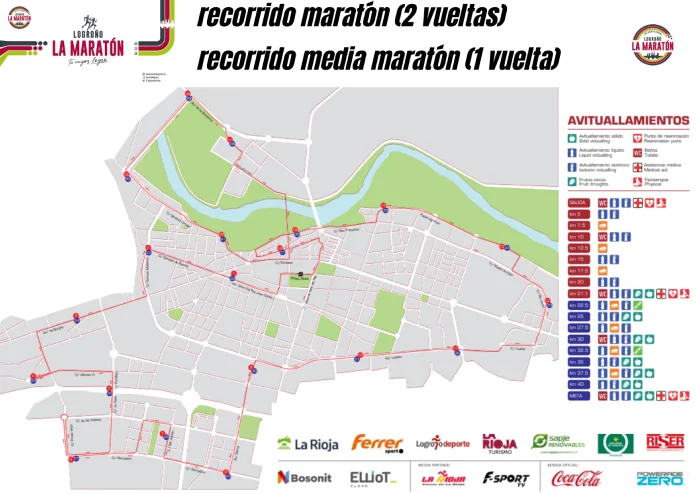
We had stumbled onto the 11th Logroño 10k, 1/2-marathon, and marathon. We heard music and announcements ahead and assumed we were near the finish line. So we followed the sound, only to find it was just one guy with a boom box and microphone.

External link: map of the Logroño marathon route
External link: map of the Logroño half-marathon route.

But there were also some sort of race marker and water tables, and some people cheering, plus the guy with the sound system had a very "radio" voice so he was probably there in some official capacity. He applauded and encouraged each runner as they straggled past. I was impressed! We encountered runners in multiple locations on our tour.

We were making our way north to the river. We passed alongside the University of La Rioja, which had a nice looking campus but not a ton of activity on a Sunday.

We reached the first of several parks running along the Ebro River, the Parque de la Ribera. There are many features in the park, of varying interest to us. But if you are able to find out why the points were marked, you can get a better feel for the people of an area and what is important to them.

Brown squirrel with acorn in tree
White bird in river
Local fauna in the park.

For example, the map calls out "Árbol singular de La Rioja. Pino piñonero del Parque de La Ribera" - it's a pine tree. It's tall and handsome for a pine, but what made it special enough to be on the map? Well, we learned that La Rioja has a catalog of singular trees, based on species, age, size, etc. and they are all marked and tracked.

Caves are visible in the cliffs above the park
Ruins of the city walls
Views from the Parque de Ribera: Caves in the cliffs above; Ruins of city walls.

The northern bank of the river abuts red-earthed cliffs and from town you can see the openings of caves carved by monks. The little detail I could find about them indicates they were carved in the 1800s, but I don't know for what purpose. It seems you can hike to them, but it's difficult.

The park also has ruins of the old city walls and a lake with fountains. My itinerary told us to stay at the river's edge and into the next park, Parque de Ebro, but one of us needed to find a bathroom. Me. It was me. It's always me.

We left the park at this point, trying to find relief. But it was Sunday and not much was open. We finally found a cafe where we got a table outside. There were plenty of families who seemed to be enjoying their afternoon after church.

We returned to the river to complete our walk of the park. We then passed through the old town area again to return to our hotel. We located a laundromat just a couple blocks away and did our washing before cleaning up for dinner.

Mural giving attention to the plight of the homeless, as we left the park. It reads, In the street you don't live, you survive. Then, another marathon encounter - this might have been the endpoint, judging from the number of people in the area. The flag is of La Rioja. Also notable are the pride bench and the British flags and underground loge - but it turns out to just be an English language school.
Mural giving attention to the plight of the homeless More marathon - possibly the end

For eats, we checked out another pinchos alley, the Calle Laurel. This street is also in the older part of town, where many narrow streets are full of restaurants and their on-foot patrons (I would say pedestrian patrons, but that might be taken as an insult).

These shops might be a cut above Calle San Juan, or maybe we just got lucky and found some more to my taste. We got some terrific foie at Bar Donosti. Farther along, we found Bar CID which features all kinds of regional mushrooms. There were so many places to choose from.

Observation: They eat a lot of mushrooms in Spain. I've been incorporating them more into my diet since visiting. You should try it - they are finding even more nutritional benefits of them, it seems.

I was surprised to see a Naando's in Calle Laurel. Our son introduced us to this chicken restaurant and its peri-peri sauce in London, and I had assumed it was English. But I just learned it was founded in South Africa. I did not expect to see any chain restaurants in this area. Common American chains we saw throughout Spain tended to be burger joints like McDonalds, Burger King, and Five Guys.

UPDATE: So, funny little story about that Naando's. You might notice the extra A. I did, and I double-checked it on Google Maps to make sure I wasn't making it up. But it got flagged when we ran an AI spell-checker so I looked it up again. It seems to be a knock-off: the real Nando's has one A and there aren't any in Spain. But this one used the same font, same logo as the real one.

Ribera pinchos bar with menus at the door The last bite of foie on toast from Bar Donosti Pile of mushrooms at Bar CID
Enticing menu at Ribera; the last bite of foie on toast from Bar Donosti; a pile of mushrooms at Bar CID.

Return to top

Monday, October 6
Bodegas Valdemar

Conde Valdemar wine barrel and bar stools
Barrel and stools invite you to sit, in the Bodegas Valdemar tasting room.
The blanco was delicious.
Up-close wine glass with white wine

Today we were leaving Logroño, heading for Pamplona. We cooked breakfast, then cleaned up and checked out. I don't think we ever saw anyone working in the apartments, though we did see some other guests coming and going. We certainly did enjoy our stay.

Pricing of the bottles from Rioja and Walla Walla - a big difference
Pricing of the bottles from Rioja and Walla Walla - a big difference.

Painted on the wall on the way to the wine making level. It reads "The three most important things in this bodega; clean, clean, clean", by Jesús Martínez Bujanda, 3rd generation.
Motto on the wall at Bodegas Valdemar

Before leaving Rioja, we had a tasting at Bodegas Valdemar, about 15 minutes out of town. We chose this winery because we have tasted their wines at their Conde Valdemar in Walla Walla WA, including sampling some Rioja wines that we really liked. We had coordinated to meet with another group of English speakers who happened to be wine club members from Washington State.

On the tour, we got a better understanding of the Rioja classifications or designations of joven, crianza, reserva, and gran reserva.

We already knew that there were criteria for how much time each spends in barrel and in bottle. Moreover, to receive the designation of gran reserva, the wine must pass a tasting panel. But we did not consider how the requirement for the winery to do more bottle aging is a bit rare, and it figures into the price of the wines.

The expectation of Rioja wines is that the bottle should be ready to drink when purchased. This makes a huge difference for someone living in a small apartment without air conditioning or proper wine storage, as is common.

We thoroughly enjoyed the tasting and took away a couple bottles that we will have to drink on our trip since we will not have space to bring much home with us.

UPDATE: We visited Conde Valdemar and joined their wine club. The Walla Walla location is run by a member of the family who studied in the US and is adding different styles of wines to the portfolio.

Following the tasting, we made the short drive to Pamplona for the next stop on our trip.

Spanish countryside between Logroño and Pamplona.
Spanish countryside between Logroño and Pamplona

Return to top

  < Previous (León) Travel Site Home France / Spain 2025 Home   Next (Pamplona) >